|
The Book of Ruth |
Chapter
4:1-12
"Ruth's Reward Part-1"
J. Deering, AncientPath.net
Download Study -
BACK TO RUTH - GROUP STUDIES
HOMEPAGE -
BACK TO AncientPath
HOMEPAGE
LAST WEEK:
We closed out Ruth and Boaz’s introduction to each
other in a more private setting – atop the wheat pile at night. What happened
there was perfectly planned and executed – “under the Law.” We found that there
was nothing in the original text that even hinted at anything immoral, or apart
from God’s standards. Boaz was the perfect honorable gentleman, and Ruth
followed Naomi’s instructions to the letter. The hardest moment, for both Ruth
and Boaz, was the problem of Boaz not being the “closest” relative who qualified
for the position of “Kinsman-Redeemer.” Boaz cannot marry Ruth. Boaz and Naomi
both make it clear that trusting the Lord God will bring about His purposes in
this matter.
The beginning of this chapter is the
story of the transaction of the redeemer. In the story of Ruth, the transaction
is that of a Kingman-Redeemer, who wants Ruth willingly and not because of the
value of her property. As far as Boaz is concerned Ruth is the only important
element of this transaction. Boaz considers Ruth not only a woman of quality but
also of deep admiration and love.
As
the nation of Israel makes its way along the path to redemption (from her sins
of idolatry, as a covenant people), back to her God, she finds a redeemer who is
anxiously awaiting her and willing to pay the price to acquire her, that is
acquire back into full fellowship – because she (Israel) wants to be back into
full fellowship.
Last week’s
Outline and Text:
III. Ruth's Reward Ruth P-2 3:10-18
F.
Praise: 3:10
Then he said, "May you be blessed of the LORD, my daughter. You have shown your
last kindness to be better than the first by not going after young men, whether
poor or rich.
G.
Protection: 3:11
"And now, my daughter, do not fear. I will do for you whatever you ask, for all
my people in the city know that you are a woman of excellence.
H.
Problem: 3:12-14
"And now it is true I am a close relative; however, there is a relative closer
than I. 13 "Remain this night, and when morning comes, if he will redeem you,
good; let him redeem you. But if he does not wish to redeem you, then I will
redeem you, as the LORD lives. Lie down until morning." 14 So she lay at his
feet until morning and rose before one could recognize another; and he said,
"Let it not be known that the woman came to the threshing floor."
I.
Provision: 3:15
Again he said, "Give me the cloak that is on you and hold it." So, she held it,
and he measured six measures of barley and laid it on her. Then she went into
the city.
II.
Progress: 3:16-18
And when she came to her mother-in-law, she said, "How did it go, my daughter?"
And she told her all that the man had done for her. 17 And she said, "These six
measures of barley he gave to me, for he said, 'Do not go to your mother-in-law
empty-handed.'" 18 Then she said, "Wait, my daughter, until you know how the
matter turns out; for the man will not rest until he has settled it today."
INTRODUCTORY COMMENTS:
The
book was written to show God's grace to those who were in a covenant
relationship to Him and had willfully wandered away, received chastisement
because of their wandering, and sought a renewed relationship, through
repentance, with their God.
We
can apply this same principle to renewing a right relationship with God when
sins remove us from His fellowship. We come to Him, in our age, (1 John 1:9 ff)
confessing our sins (idolatry) and a renewed fellowship based on the shed blood
of Jesus.
As we
look at these verses, we also see the application that can apply to those who do
not know God, who have turned and forsaken their sin and are approaching their
redeemer in terms of salvation. His character is the same. He is loving, caring,
and looking forward to the redemption of all those who would come. He awaits us
as his bride. Those who come to Him only to do as Ruth does, believe in Him (The
Christ, Jesus) as the one who redeems, and to rest in His willingness and power
to be that redeemer.
Boaz
represents God (and Jesus the Christ, The Willing Redeemer) in these verses. We
see that he is the one who in offering to be the redeemer, especially when he
has no interest in wealth or property that we might have to offer, says "I will
redeem." This redemption is based purely upon his character and his love.
After
Boaz has made the transaction, the elders offer a great blessing upon him
because of his selfless act. There are two blessings offered here. The first is
that Boaz and Ruth would be blessed like Rachael and Leah. These two women were
sisters who married the patriarch, Jacob. They were the mothers of most of the
tribes of Israel. They were also Gentiles.
The
second blessing is that Boaz and Ruth would be blessed like Perez who was the
son of an incestuous relationship between his mother (Tamar) and her father
(Judah). The blessing was for a multitude of families to come out of them.
God worked through them in a mighty way and produced the lineage that would
bring forth not only the nation of Israel, but the tribe of Judah from which not
only King David would come but also the Messiah, Jesus, The Christ.
THE VISUALIZED TEXT (NASB) (conjunctions
& prepositions (and other important words) underlined, words not in
original text in italics) (alternate
text in purple)
Ruth's Reward Ruth 4:1-22
F.
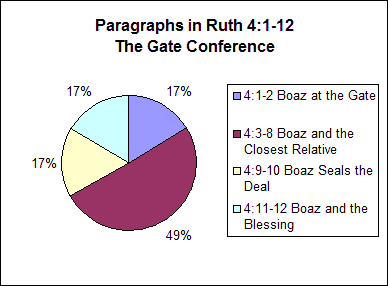
Gate Conference: 4:1-12
1.
Boaz At The Gate: 4:1-2
Now
Boaz
went
up to the gate and
sat down there, and
behold,
the close relative of whom Boaz spoke
was passing by,
so
he
[Boaz]
said,
"Turn aside
[from his walk by],
friend,
sit down here." And
he [the close
relative]
turned aside and
sat down.
4:1 Comments
While
much of the book has been about the plans of Naomi, now Boaz – on his own – gets
to promote his promised role of redeemer for Naomi through Ruth, and also the
promised role of Levirate Husband for Ruth. During much of the book it is easy
to confuse these two goals.
Naomi
needs a kinsman-redeemer in order to get out of abject poverty. She has lost her
husband and her children, and only has temporary rights to her late husband's
property. Upon her death, since her male children are already deceased, all of
Elimelech's property rights will be acquired by someone outside the family that
Elimelech established with Naomi. Ruth’s kinsman-redeemer would be able to
acquire Elimelech's property rights and restore them to Naomi and herself
through Boaz.
Naomi
would need a Levirate husband to continue her family line and provide a
hereditary lineage, but she is too old to produce children (the whole point of
the Levirate Marriage law).
Ruth,
wife of Elimelech's late son Mahlon, has no male children to establish the
family inheritance line either. However, if she were to find a willing Levirate
husband then she also would be the benefactor of a redeemer who was able to
father male children.
Boaz fulfills both needs. He
is able to redeem Naomi (her land and property) and redeem Ruth (a wife who can
bear children) in a single act.
The
purpose of the dialog with the "close relative" is to demonstrate that Boaz is
the only one WILLING to redeem at any
cost.
2
And
he [Boaz]
took ten men of the elders
of the city and said, "Sit down here."
So, they sat down.
Brief Commentary on Ruth 4:2
It
takes a minimum of 10 Jewish men of at least 30 years old to have a synagogue.
The inference here is that there is a whole synagogue full of elders present to
authenticate the transaction that is about to be made. They are the official
witnesses of this important transaction of redemption. He has called them and
they agree, indicating by their willingness to sit with him.
2.
Boaz And The Closest Relative 4:3-8
3
Then
he
[Boaz] said to the closest relative,
"Naomi,
who has come back
from the land of Moab,
has to sell the piece of land
which belonged to our brother
Elimelech.
Brief Commentary on Ruth 4:3
Boaz
explains the situation that Naomi brings to the table. Land – In the Israel of
the day you could not buy land. You could buy the rights to the use and harvest
the land, but the actual land remained in the family who originally had it
granted to them. Boaz is bringing a deal to this close relative that will allow
him to "own" and receive the income from Naomi's land, in exchange for paying a
price to her. This land was owned by Elimelech, he was dead, but Naomi had
control of it for the rest of her life, as the widow.
4 "So
I [Boaz]
thought
to inform you, saying,
'Buy it
before [in front of]
those who
are sitting here, and
before the elders
of my people.
If you will redeem it,
redeem it; but
if not,
tell me that I may know;
for there is no one but you
to redeem it, and
I am after you.'"
And he [the first redeemer]
said,
"I will redeem it."
Brief Commentary on Ruth 4:4
This
land was an important article in Jewish life. The redeemer could purchase the
land, paying Naomi for its use, and it would always continue to be part of the
family inheritance. It was a deal for the redeemer because it gave him first
choice in the matter of acquiring income producing land.
Boaz
goes on to tell this closest relative that if he does not want it then he, Boaz,
would redeem it himself. This was to say, it is an incoming producing piece of
property, and if you don't want the income then I'll purchase it myself… but…
5 Then
Boaz said,
"On the day you
buy the field from the hand of Naomi,
you must also
acquire Ruth
the Moabitess,
the widow of the deceased,
in order to
raise up the name
of the deceased
on his inheritance."
Brief Commentary on Ruth 4:5
But
– and there seems always to be a "But" in a deal that seems too good. But, if
you acquire the land or Naomi – you also acquire her Moabite daughter and you
must marry her as Levirate.
6 And
the closest relative said,
"I cannot redeem it for myself,
lest I jeopardize my own inheritance.
Redeem it for yourself;
you may have my right of
redemption,
for I cannot redeem it."
Brief Commentary on Ruth 4:6
The
"closest relative" balks at this information. Another wife? What will happen to
my own family if this transaction interferes with their inheritance. More
Children? What if Ruth's first child is a boy and all I have is girls, will he
get everything? We can conjecture all kinds of reasons, but the text does not
tell us. The "closest relative" says, "NO. I cannot redeem it."
(4:7a)
Now
this was the custom
in former times
in Israel
concerning the redemption and
the exchange of land
Brief Commentary on Ruth 4:7a
Our
narrator enters here to say (at the time that the book was written, probably at
about the time of the ascension of David to King of Israel) the custom of shoe
removal was no longer practiced, and therefore was already degraded to the form
it is found in the next verse (the time of the events of the book of Ruth) from
the version in Deuteronomy as law a few hundred years earlier.
(4:7b)
to confirm
any matter:
a man
removed his sandal and
gave it to another [probably “the
other”];
and
this was the manner of attestation in Israel.)
Brief Commentary on Ruth 4:7b
This
custom does not refer to the law about refusing to marry a brother's widow but
was usual in the transfer of inheritances: for this relative was not a
brother, but simply a kinsman; and the shoe was not pulled off by Ruth, but by
the kinsman himself and it was his common sandals – not the dual skinned
marriage shoe. The Targum renders, instead of his shoe, "his
right-hand glove," it probably being the custom, in his time, to give that
instead of a shoe. Jarchi says, "When we purchase anything new, it is
customary to give, instead of a shoe, a handkerchief or veil." Deut 25:7-10
8 So the closest relative said to
Boaz,
"Buy it for yourself."
And he removed his
[the closest redeemer] sandals.
Brief Commentary on Ruth 4:8
In
the Law version [the Torah, not the Targum] the woman seeking redemption of a
redeemer who would not redeem her would remove a special shoe from the right
foot of the proposed redeemer (indicating the breaking of a covenant) and
spitting in his face (indicating the shame and loss of respect by the defaulting
redeemer). By Ruth's time the law had been reinterpreted many times and the
tradition had changed to the self removal of a shoe(s), which sometimes was
coupled with spitting upon the ground.
Boaz
Seals The Deal 4:9-10
9
Then
Boaz said to the elders and all the people,
"You are witnesses today
that I have bought
from the hand of Naomi
all that belonged to
Elimelech and
all that belonged to
Chilion and Mahlon.
Brief Commentary on Ruth 4:9
With
the "closest relative" now out of the picture Boaz can redeem Naomi and marry
Ruth.
10
"Moreover,
I have acquired Ruth
the Moabitess,
the widow of Mahlon,
to be my wife
in order to
raise up the name
of the deceased
on his inheritance,
so that
the name
of the deceased
may not be cut off
from his brothers or
from the court of
his birthplace;
you are witnesses today."
Brief Commentary on Ruth 4:10
Boaz
makes clear his intentions for Ruth and the legal reasons for his actions. He
makes sure that the elders know that they are the legal witnesses in this
transaction.
Boaz And
The Blessing 4:11-12
11
And all the people
who were in the court,
and the elders, said,
"We are witnesses.
May the LORD make the woman
who is coming into your home
like Rachel and Leah,
both of whom built the house of Israel; and
may you achieve wealth
in Ephrathah and
[may you]
become famous
in Bethlehem.
12 "Moreover,
may your house
be like the house of Perez
whom Tamar bore to Judah,
through the offspring
which the LORD shall give you
by this young woman."
Brief Commentary on Ruth 4:11-12
The
blessing that is presented here is unusual in that Rachel, Leah, and Tamar are
all Gentiles, grafted into the nation of Israel and God's plan a very long time
ago. The elders indicate that because of these women the "house of Israel" was
"built" by these women – that their offspring were noble, productive, and
prophetic. These families were the cornerstone of Israel in producing the family
of Judah, the Davidic line, which eventually produced Messiah.
The Book of Ruth Bible
Study materials on this website are a ministry of AncientPath.net and are made
available here free and may be copied for use in Bible study groups, in limited
numbers, providing that no charge is made for them. Items that appear as
copyrighted materials that are not of our authorship are not to be copied
without the express permission of the original copyright holders. Every effort
has been made to give proper footnote credit for items that are quoted.
No further distribution or use of these materials is allowable under U.S. or
International Copyright Law without the express permission of AncientPath.net.
©2008
AncientPath.net,
All rights reserved.
J. Deering [AncientPath.net] is the author and editor of this study.
AncientPath.net © 2024
Jeremiah 18:15
"Don't stumble from the Ancient Path.”
2024-06-05 Original Class
Date
2025-03-28 update