
|
The
Book Of Ruth |
Chapter
3:1-9
"Ruth's Reaping"
J. Deering, AncientPath.net
Download Study -
BACK TO RUTH - GROUP STUDIES
HOMEPAGE -
BACK TO AncientPath
HOMEPAGE
LAST WEEK:
We introduced the major characters of the
Book of Ruth and their journey from Israel to Moab. Here’s our outline and text
for what we covered.
I.
Ruth's Reaping Ruth 2:1-23
A.
Guidance to Boaz's Field: 2:1-3
B.
Gleaners in Boaz's Field 2:4-7
C.
Grace from Boaz 2:8-14
D.
Gleaning from Boaz's field: 2:15-18
1.
Don't embarrass Her: 2:15
When she rose to glean, Boaz commanded his servants, saying, "Let her glean even
among the sheaves, and do not insult her.
2.
Provide For Her: 2:16
"And also you shall purposely pull out for her some grain from the bundles and
leave it that she may glean, and do not rebuke her."
3.
Ruth's Abundance: 2:17-18
So she gleaned in the field until evening. Then she beat out what she had
gleaned, and it was about an ephah of barley. 18 And she took it up and went
into the city, and her mother-in-law saw what she had gleaned. She also took it
out and gave Naomi what she had left after she was satisfied.
E.
Glad for Blessing: 2:19-23
1.
I Gleaned With Boaz: 2:19
Her mother-in-law then said to her, "Where did you glean today and where did you
work? May he who took notice of you be blessed." So, she told her mother-in-law
with whom she had worked and said, "The name of the man with whom I worked today
is Boaz."
2.
The Kinsman-Redeemer: 2:20
And Naomi said to her daughter-in-law, "May he be blessed of the LORD who has
not withdrawn his kindness to the living and to the dead." Again, Naomi said to
her, "The man is our relative, he is one of our closest relatives."
F.
Safety in Boaz's Field: 2:21-23 Then Ruth
the Moabitess said, "Furthermore, he said to me, 'You should stay close to my
servants until they have finished all my harvest.'" 22 And Naomi said to Ruth
her daughter-in-law, "It is good, my daughter, that you go out with his maids,
lest others fall upon you in another field." 23 So she stayed close by the maids
of Boaz in order to glean until the end of the barley harvest and the wheat
harvest. And she lived with her mother-in-law.
INTRODUCTORY COMMENTS:
Chapter 2 introduced
us to the central theme of the book, which is Redemption through a
Kinsman-Redeemer.
We want to keep stressing our three applications of this
book.
1. The Story itself.
2. Parallel 1 Israel
at that time
3. Parallel 2 believers now
Ruth 3:1-4 Ruth’s
Rest, 3:1-8
A.
The
Plan, 3:1-4
B.
The Promise, 3:5
C.
The Promptness, 3:6
D.
The Presence, 3:7
E.
The Predicament, 3:8-9
THE VISUALIZED TEXT (NASB) (conjunctions
& prepositions (and other important words) underlined, words not in
original text in italics) (alternate
text in purple)
(3:1)
Then
Naomi
her
[Ruth's] mother-in-law
said to her
[Ruth],
"My daughter,
shall I not seek security for you,
that it may be well with you?
Brief Commentary on Ruth 3:1
This paragraph begins with the word “Then,”
a clear indication from the author that something “new” is going to happen now.
About three
months have passed between chapter 2:23 and 3:1. The harvest is now complete.
Living together now in Ruth's care has had such an impact on her that she now
refers to Ruth as "my daughter" instead of "my daughter-in-law”. Naomi sees that
Ruth's everyday experience of being under the care of Boaz is rapidly coming to
an end. Naomi has had time to develop a plan that should result in Ruth and Boaz
being married. Naomi's heart is in the right place: this plan should
bring about security for her as well as Ruth.
As you can see by the
titles in the "Brief Outline" above (The Plan), this paragraph is mostly about
the plan of Naomi for Ruth.
In these four verses
Naomi explains to Ruth her plan to bring security back into Ruth's life and her
own as a byproduct. Naomi's security is closely tied to Ruth's in this plan and
Naomi already knows of Ruth's faithfulness to her.
Ruth may be in the
dark about much of Naomi's plan, but Naomi is not being deceitful. Ruth would
have little cultural experience in Judaism. She would not have knowledge of
Jewish law, traditions, culture and rituals, but Naomi does.
Naomi knows of Boaz's
heart towards Ruth. She has seen all the evidence of Boaz's love for Ruth during
the past three months of the harvest season. He wants Ruth to keep coming to the
fields. He wants Ruth to be well cared for while she is in the fields. He makes
sure that Ruth has much to take home for both her and Naomi.
Naomi also knows that
Boaz is a family kinsman-redeemer. But, she also knows that Boaz is not the
closest male member of her late husband's family – so her plan must be made with
much craft in order to work.
Ruth must go to Boaz in such
a way that
if he will not, or cannot, accept Ruth's
request for him to fulfill the Levirate Marriage law with her, that he will not
suffer any embarrassment or disgrace to himself or family from them.
Three things you should look
for: 1 –
Ruth's humble willing submission at the feet of Boaz while seeking her redeemer.
2 –
The nation of Israel's humble willing submission to her God upon her seeking to
be redeemed back into His fellowship.
3 –
The individual believer's (as members of the Church) humble willing submission
placing themselves approaching Christ as "The Bride of Christ" in preparation
for the "Marriage Feast of The Lamb."
(3:2)
"And
now
is not
Boaz
our kinsman,
with whose maids you were?
Behold,
he winnows barley
at the threshing floor
tonight.
Brief Commentary on Ruth 3:2
“And now…” Again, the
leading words are meant to intrigue us as to the immediate future.
This is the resolve
of the story. First the was the move away from Judah and God, then there was the
inference of idolatry in the family, then there was chastisement and death, then
there was the long hard return, then the not so welcome reception, then the hard
months of working for provisions in the fields.
In the “way back past” I remember “Johnny
Carson and the Tonight Show.” The Announcer, Ed McMahon would announce, “And
Now, The Tonight Show with Johnny Carson,” and the band would play the show
theme – it always caused a great amount of applause and cheering.
“And Now,” Naomi knows that Boaz, the master
of the fields that Ruth has been working in for these months will be having his
dinner at the threshing floor and sleeping there. How, you ask? Tradition is the
answer. The owners of each field spend the late afternoon winnowing and taking
stock of their harvest grain. They then sleep in the enclosure where the grain
is kept (keeping it dry and safe) every night until the grain is either
permanently stored or sold for profit. Nobody protects their property better
than the owner. Research indicates that this has been the custom for thousands
of years in Palestine and it is probably still practiced on smaller farms.
"And Now" comes the awaited answer to the plot of the
story. "And Now – The Redeemer!" “And Behold” … Behold is a word that is closely
connected with "looking." Just like in English when you wish to get someone to
understand a major point – "Look,
tonight is the night!"
(3:3)
"Wash
yourself therefore, and
anoint
yourself and
put on your best clothes, and
go
down to the threshing floor;
but
do
not make yourself known to the man
until
he
has finished
eating and
drinking.”
Brief
Commentary on Ruth 3:3
What seems like
a suggestion to Ruth to get cleaned up is more accurately the readying of Ruth
to make her proposal of Levirate marriage to Boaz. She must present herself as
his possible bride "without spot."
Naomi's instructions to Ruth would allow
Ruth to make her bid for kinsman-redeemer in a private manner. If Boaz needed to
reject his responsibilities as kinsman-redeemer both he and his family would
suffer disgrace (under the law). So, Naomi tells Ruth to go after Boaz has
settled himself, after dinner, and gone to bed.
Privacy, privacy,
privacy. Naomi does not want Ruth (who may be somewhat ignorant to the
understanding of the Jewish traditions) to embarrass Boaz in any way by being
seen.
The question often
comes up, “Does the term “eating and drinking” indicate that this is an
inappropriate act? Unfortunately, that is often taught, but there is absolutely
nothing in the text that indicates any impropriety whatsoever. Even the word for
“merry” (KJV) in verse 7 only means that a full meal at the end of the day tends
to make one happy and relaxed. While the KJV translation was without bias in its
day about the word “Merry” it has become a word associated with drunkenness in
our day and culture.
(3:4)
"And
it
shall be when he lies down,
that
you shall notice the place where he lies, and
you shall go and uncover his feet and lie down;
then
he
will tell you what you shall do."
Brief Commentary on Ruth 3:4
Ruth is to take
note where Boaz beds himself. Certainly, sleeping in the grain room, in the open
field, in the late spring would be a chilly affair and Boaz would have covered
himself to stay warm, perhaps even more so at his feet.
Ruth is told to
go and uncover his feet and place herself there at his feet. While many desire
to see much more in these words (climbing into bed with Boaz) the text is pretty
clear: "Uncover his feet and lie down." I don't know of a better way to wake a
man up without touching him or calling his name than to expose his feet to the
cold air of the night, and then place a warm body against their bottoms. The
strongest reason for doing this is to fulfill the traditional and cultural
demands of the Levirate Marriage rite. Ruth must place herself at his feet in
order to present herself and her proposal of marriage under this law. Don't look
for immorality here – remember that the story is about honor, devotion, and
love. The story typifies Christ as the "Kinsman-Redeemer," and Ruth as the
submitting "Bride of Christ."
We need to make a note about Naomi telling
Ruth “Then, he will tell you what you shall do." Ruth had been Mahlon's wife for
several years. There is no doubt that she knows how to please a husband and she
certainly wouldn't need to be "told what to do." But instead, see Ruth as coming
to her Kinsman-Redeemer, under the law – She is a Moabite, completely unfamiliar
with the law – needing the knowledge of what is next in this proposal – "Under
the Law?"
And Boaz…
Boaz had
befriended Ruth over the past three months and has treated her very special
during this time. The possibility of a Levirate marriage has, of course, crossed
his mind. He has probably hoped against hope that Ruth would reciprocate his
desires because of his advanced age (probably about Naomi's husband's age). But
hope springs eternal and if in fact Ruth did ever approach him in the prescribed
way of the ritual, then he would be ready).
Verse Percentage Chart for Ruth 3:1-4
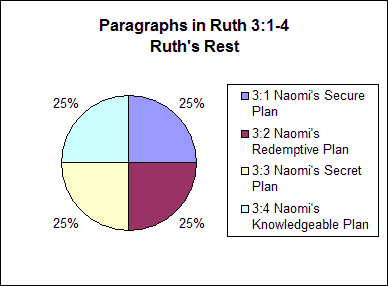
Equal attention to each of the four verses in
this paragraph.
The Promise, Ruth
3:05
And
she
[Ruth] said
to her [Naomi],
"All that you say
I will do."
Brief Commentary on Ruth 3:5
Specifically, Ruth hands over her fate to Naomi's wisdom completely. Ruth has
put her trust in the directions of Naomi, her Mother-in-law, and she will follow
whatever directions Naomi gives to her in this matter. This is the culmination
of several years of relationship between Naomi and Ruth. Ruth has left her
country, her people, and her gods to pursue the God of Abraham, Isaac, and
Jacob. Ruth had not heard or seen anything along the way that she had made a
mistake – even though things had been tough. Naomi was too old to work the hard
labor of the fields and Ruth did it. Ruth provided the sustenance, Ruth provided
the food, and Ruth provided the opportunity for the future. Naomi has provided
the courage, the knowledge, and the insight. A redeemer waits, and Ruth is on
the way.
Verse Percentage Chart for Ruth 3:5
INTRODUCTORY COMMENTS: Ruth 3:6
Isn't
it wonderful when you find someone who has heard good advice and then acts upon
it. The removal of the self will in important matters. Naomi represents the
loyal portion of the Nation of Israel, encouraging, recommending, advising, and
nurturing the recently back-sliding portion of the nation towards their redeemer
(remembering that they are not coming for salvation but to restoration of their
former position).
In quite another way Naomi also represents the loyal
members of the Body of Christ (inside or outside of the local church) who give
their lives and their energy to restoring back-sliding believers into fellowship
with Christ, and back into fellowship with other believers. God bless the
Naomi's of this world. They stand along side troubled believers and give their
full support, showing them the way, making straight their paths, that they might
be restored into full fellowship. Like in the story, Ruth has already (perhaps
years ago) turned from idols to God. As a "believer" she has found herself
outside the circle of fellowship in the nation, she was coming from "another
country." She needs a "Kinsman-Redeemer" to bring her back, to buy her back,
someone who will pay for her heart.
Although not
directly, the point of the story of Ruth is the easy application of her
situation to parallels in repentance. Whether it is amongst individuals in the
ancient nation of Israel or since the life, death, and resurrection of Jesus,
the process of "turning around to Him" has been always the same.
Finding Him, being introduced to Him, and then making Him the only thing
anywhere of any value to you.
In the area of
Salvation, the true believer says "You, dear LORD, only You, and nothing else, I
must have You." Even if you fall on your knees in sorrow for your sin, even if
you turn away from sin and other gods, if you do not find Him as your "One and
only," it is all for naught. God is looking for those who only desire Him, and
when that happens, we find ourselves face to face with Jesus the Savior and the
recipients of His saving Grace. Hear His promise, listen to His plan, and then
act with "Promptness." Tomorrow may be too late.
THE VISUALIZED TEXT (NASB) (conjunctions
& prepositions (and other important words) underlined, words not in
original text in italics) (alternate
text in purple)
(3:6)
So
She
went down to the threshing floor and
did according to all
that her mother-in-law had commanded her.
Brief Commentary on Ruth 3:6
The word "so" indicates to us that what happens in this
verse (and others that follow) is the result of actions taken in the previous
verse or verses.
First, we’ll take a moment and talk about just why Ruth
had to go DOWN to the threshing floor. You have probably heard the expression “I
must go UP to Jerusalem.” In Israel, Jerusalem is always “up” to get there, both
symbolically and physically. It’s then pretty normal to refer to anywhere that’s
not Jerusalem, or any direction, as “Down” from where you are at that moment.
Naomi has given instructions to Ruth on how to approach
this delicate matter. Now it is up to Ruth. Her response is immediate. What
trust Ruth has in Naomi, what a wonderful relationship these two women have with
each other. Naomi is the mature nurturer and Ruth is the young willing learner.
Ruth now has Naomi's plan and begins to put it into action. The intention of
both women is to acquire the attention of Boaz. We know that he has interest in
her and that he is a generous caring man.
Everyone in the story knows that he is family and a
possible kinsman-redeemer for either Naomi or Ruth. Naomi and Ruth know that
Naomi is not a good candidate to put forward for acceptance by a
kinsman-redeemer. The point of such a law is that the bride will be able to bear
children in order to continue the family line and the property that goes with
it. God had purposefully put this into the law in order to continue Abraham's
covenanted people, forever. Under Jewish law the land and its harvest belong to
God. The people of Israel are only caretakers. The land has been divided between
the tribes of Israel and the law states that it should never be sold or divided
up – it is His!
Once every fifty years all land transactions are
cancelled out and everything returns to its original land granted families who
have been chosen as official caretakers
of those portions, but it is not theirs, it is His.
Ruth is the best
candidate. She is young, and thanks to Naomi, she has caught the eye of a
possible kinsman-redeemer, Boaz. Now in verse 6 Ruth has taken action.
Verse Percentage Chart for Ruth 3:6
INTRODUCTORY COMMENTS Ruth 3:7
The scene shifts now
to Boaz. There are times in a man's life when he considers himself to be happy.
Here he is at the end of a very successful harvest. The grain is in, and Boaz is
not only master of the field, but of the harvest. He has done a years work in
preparation for this time. Sewing the seed, plowing, watering, that is all done
now. The worry over too little or too much rain, the ever-present threat of fire
– it is all behind him now.
He sits quietly now
and enjoys a meal before bedtime as he watches over his grain. Now the worry has
shifted to robbers coming to the field at night and taking the grain. As master
of the harvest, it falls to him to sleep there with the grain, watching over it.
Can you see him there? Can you see him crawling up on top of a sun warmed pile
of grain, pulling a covering over him and settling down for a good uninterrupted
sleep? He closes his eyes … and he's asleep quickly.
His sleep will be
interrupted, however. A young lady, dressed in marriage clothes, has entered the
grain room. She has come to make the traditional proposal for marriage – a very
special kind of marriage – the Levirate marriage.
She crouches down and uncovers his feet, as she has been
instructed to, and places herself there in the place of submission awaiting his
attention and response to this traditional request to the Kinsman-Redeemer.
THE VISUALIZED TEXT (NASB) (conjunctions
& prepositions (and other important words) underlined, words not in
original text in italics) (alternate
text in purple)
(3:7)
When
Boaz
had eaten and
drunk and
his heart was merry,
he went to lie down
at
the end of the heap of grain; and
she
came secretly, and
uncovered his feet and
lay down.
The word When introduces to yet another change of
scene. We are now introduced to
Boaz and his
situation. Then we are introduced to “She”
that we know as Ruth. Many scholars over
the centuries have commented on the skilled storytelling that makes for the Book
of Ruth. Placements of characters, thoughts, and special moments make the book
so delightful.
Specifically, the
text tells us that Ruth does what Naomi has requested. Ruth waited in secrecy
for the moment when Boaz had finished his dinner and fallen asleep for the night
upon his warm grain. She has come under the cover of darkness and willingly
placed herself into the position of submission. Now comes the waiting – will he
awake? Will he wake up and find the love of his life there, or will he find just
a deluded servant girl? What will he do? Will he be happy or angry? Will he
embrace her as his wife, or will he rape her and discard her? The risks are
many.
This was an errand
that if Boaz refused the responsibility of becoming her husband (via Levirate
law) then he and his family would suffer dishonor in the community. God made it
quite clear that this was an important responsibility to Him and the community
would feel that way as well. Ruth would be in a place of public shame if she was
an "unwanted" woman as well.
Ruth uncovers
Boaz’s feet… for feet play a large role in Jewish traditional and symbolic life.
One who places themselves at another's feet voluntarily is a "Bond Servant." A
free slave who chooses servanthood based on the character of the one who is
served. Becoming one's footstool is one who has become subservient. One who
washes another's feet is the lowest servant (the position of a priest). The feet
are where there should be no barrier to touching the ground where holiness is.
If Boaz, once he becomes the rightful Kinsman-Redeemer, refuses to take that
responsibility he must put on a special shoe, made of Kosher animal skin, that
is sewn together in two pieces (His and Hers, the stitch binding the two
together), proclaim his unwillingness to fulfill the law, and then remove the
shoe, cast it away. The woman requesting this opportunity then spits in his
face. Then he spits on the ground (spitting upon the holy ground of God and His
law). With the uncovering of Boaz's feet, she willingly asks the question "will
you marry me?")
Verse Percentage Chart for Ruth 3:7
INTRODUCTORY COMMENTS RUTH 3:8-9
The Predicament! Just
as the text says, "It happened in the middle of the night." Ruth has
successfully arrived at the threshing floor (the storage barn at the threshing
floor) and secretly made her way to the feet of Boaz. Boaz is sleeping
peacefully and probably dreaming of the great wealth of grain or that pretty
young thing that keeps coming to the fields to glean, perhaps even dreaming that
he might one day be asked to marry her.
A touch, to his feet,
a feeling that someone is there. He is alarmed and quickly reaches forward for
the intruder – someone has come to steal his grain! Behold, it is a young woman
– in a wedding gown! … I'm dreaming!
THE VISUALIZED TEXT (NASB) (conjunctions
& prepositions (and other important words) underlined, words not in
original text in italics) (alternate
text in purple)
(3:8)
And
it happened
in the middle of the night
that
the man
was startled and
bent forward;
and behold,
a woman was lying at his feet.
Brief Commentary on Ruth 3:8
If we've paid attention to the story, we know that
Boaz has a strong attraction to Ruth. He has been taking very special care of
her when she comes to glean. He knows that she is gleaning because she has no
husband, is the daughter-in-law of Naomi, and Naomi is his "close relative's"
late wife. He also knows that Ruth is available (wife of the late Mahlon, son of
the late Elimelech, for the Levirate marriage arrangement, but he is not the
closest relative – and he's much older than she. "Hope against hope."
We know that Naomi has
encouraged Ruth to continue to encourage Boaz because she knows that, even
though he may not be the first one in line, he is wealthy, owns much property,
and has already taken an interest in Ruth – but not immediately available. "Hope
against hope."
We also know that Ruth,
even though she has been more or less a silent partner in all this plotting, has
taken so much of a liking to Boaz that she is quite willing to follow Naomi's
plan to capture Boaz as her family's kinsman-redeemer. "Hope against hope."
(3:9)
And
he said,
"Who are you?"
And
she answered,
"I am Ruth your maid.
So spread your covering over your maid,
for you are a close relative."
Brief Commentary on Ruth 3:9
"Who are you?"
he cries out thinking someone may be there to steal his grain. "It's me, Ruth,
asking for your hand in marriage under the Levirate Ritual law! Spread your
protection over me and my family by taking me as part of your family (spread
your covering over your maid). "Please accept my plea." (Please excuse my rough
translation).
Herein lies the
"predicament." Naomi wants them together. Boaz wants them together. Ruth wants
them together. He does not qualify under the law to do this righteously. If you
were a Jew reading this story you would see this coming. At this point in the
story, you would clearly see the predicament even though it has not yet been
announced in the text. You would say to yourself, "Ah, Ha, what are they going
to do about it?"
If Boaz and Ruth
make love there on the pile of grain and He does not marry her then they are
both guilty under the law.
If Boaz uses
Ruth's desire for Levirate marriage to his advantage, sleeps with her, and then
does not marry her, they are both guilty under the law.
If Boaz and Ruth
consummate the Levirate marriage now, he and she become transgressors of the
law. He and she would be committing fornication and immorality under the law. He
does not qualify for the position of Levirate. He is not the qualified
kinsman-redeemer.
If someone
should see them together, at night, alone, on the grain pile, they both will be
shamed and thought to be breakers of the law. – The Predicament! Is Boaz a
Righteous man? What will he do?
"Why did she ask Boaz to "spread your cover over
me"?
Conservative scholars, both Jewish and Christian,
remark that the request was for Boaz to place her under the protection of His
faith in God. ""Ruth said, "Take me under your
wing (kanaph)." Cover me, is a term of intimacy. Boaz was an honorable man
and did the honorable thing. They were married, and she became his bride.
Here she was a Moabite woman from a foreign country, grafted into the nation of
Israel, like believers of all time are grafted into the Vine which is The Lord
Jesus. Boaz and Ruth are listed in the genealogy of King David and therefore of
Y'shua ben Yosef (Jesus, son of Joseph). She had the right to be covered
by her spouse's Tallit. This is a symbolic expression of marriage. (In some Mid
Eastern cultures, they cast a garment over one being claimed for marriage.)" "In
Ezk.16: 8 YHVH speaks to Jerusalem and likewise says, "so I spread my wing
(kanaph) over you and covered your nakedness," and in Psalm 91 we are able to
"abide under the shadow of the Almighty" and "under His wings (kanaph).""
*2
It needs to be pointed out here that Boaz (3:9) did
not cover her with his garment (kanaph – wing, tallit). Instead, as we will soon
learn, he explained why he could NOT declare her as his wife (by covering her in
the ritual) at this time – there was another who had the "right of first
refusal" upon her request for Levirate marriage. He goes on to further state
that if Redeemer #1 will not fulfill his duties as Kinsman-Redeemer with Ruth,
then he, Boaz, certainly will."
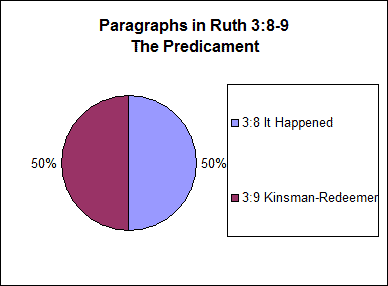
Verse Percentage Chart for Ruth 3:8-9
 +
+
The Book of Ruth Bible Study materials on this
website are a ministry of AncientPath.net and are made available here free and
may be copied for use in Bible study groups, in limited numbers, providing that
no charge is made for them. Items that appear as copyrighted materials that are
not of our authorship are not to be copied without the express permission of the
original copyright holders. Every effort has been made to give proper footnote
credit for items that are quoted.
No further distribution or use of these materials is allowable under U.S. or
International Copyright Law without the express permission of AncientPath.net.
©2008
AncientPath.net, All rights reserved.
J. Deering [AncientPath.net]
is the author and editor of this study.
AncientPath.net © 2024
Jeremiah 18:15
"Don't stumble from the Ancient Path.”
2024-05-22 Original Class Date
2025-03-28 update