|
The
Book Of Ruth |
Chapter
2:8-14
"Ruth's Reaping"
J. Deering, AncientPath.net
Download Study -
BACK TO RUTH - GROUP STUDIES
HOMEPAGE -
BACK TO AncientPath
HOMEPAGE
LAST WEEK:
We introduced the major characters of the
Book of Ruth and their journey from Israel to Moab. Here’s our outline and text
for what we covered.
I.
Ruth's Reaping Ruth 2:1-23
A.
Guidance to Boaz's Field: 2:1-3
B.
Gleaners in Boaz's Field 2:4-7
C.
Grace from Boaz 2:8-14
1.
Stay Here: 2:8
Then Boaz said to Ruth, "Listen carefully, my daughter. Do not go to glean in
another field; furthermore, do not go on from this one, but stay here with my
maids.
2.
Provision: 2:9
"Let your eyes be on the field which they reap and go after them. Indeed, I have
commanded the servants not to touch you. When you are thirsty, go to the water
jars and drink from what the servants draw."
3.
Why Favor Me?: 2:10
Then she fell on her face, bowing to the ground and said to him, "Why have I
found favor in your sight that you should take notice of me, since I am a
foreigner?"
4.
I Have Been Told: 2:11
And Boaz answered and said to her, "All that you have done for your
mother-in-law after the death of your husband has been fully reported to me, and
how you left your father and your mother and the land of your birth and came to
a people that you did not previously know.
5.
Boaz Blesses: 2:12
"May the LORD reward your work, and your wages be full, from the LORD, the God
of Israel, under whose wings you have come to seek refuge."
6.
Ruth's Thanks: 2:13
Then she said, "I have found favor in your sight, my lord, for you have
comforted me and indeed have spoken kindly to your maidservant, though I am not
like one of your maidservants."
7.
Abundance From Boaz: 2:14
And at mealtime Boaz said to her, "Come here, that you may eat of the bread and
dip your piece of bread in the vinegar." So, she sat beside the reapers; and he
served her roasted grain, and she ate and was satisfied and had some left...
Chapter
2 introduced to the central theme of the book, which is Redemption through a
Kinsman-Redeemer.
1. The
Story itself.
2. Parallel 1 Israel
at that time
3. Parallel 2
believers now
Chapter
2:15-23 brings us to six separate provisions for the beginning of her
relationship with Boaz – the yet unknown Kinsman-Redeemer. She only now knows
him as someone who is making provisions for her. He is a relative of Naomi. Ruth
has already expressed her thanks to him in his provisions, mostly because she is
not a Jew, but a foreigner from Moab. Boaz has already put his blessing upon her
presence in his fields. He has even asked her to sit and eat with his reapers,
“and she ate and was satisfied and had some left.”
Gleaning From Boaz’s Field: 2:15-18
Provision Number 1:
“Don’t Embarrass Her”
Ruth 2:15
When
she rose to glean,
Boaz commanded his servants, saying,
"Let her glean even among the sheaves, and
do not insult her."
Brief Commentary on Ruth 2:15
This paragraph begins with the word “When.” The word
should give us pause to think about the things that have just happened to her.
She was asked to join the other reapers (those employed by Boaz to cut the grain
and bundle it) and go to a shady place and have rest and water. There she meets
and talks with Boaz the owner and master of the field. He has placed his
blessing upon her. He asks her to have a meal there as well. And then, “When”
she gets up and heads back to where she was gleaning…
she got back on her feet
and headed out with the reapers to resume gleaning along behind them. As she was
going Boaz tells his servants to let her glean, and even glean around the
already cut and bundled grain – this is quite remarkable and unexpected. She had
come from Moab; she had been a Moabite and one who had been faithful to her gods
until she met Mahlon and Naomi. It was there that she found The God of Abraham,
Isaac, and Jacob. Boaz instructs his servants not to insult her and her former
predicament. She has come to the Field of Boaz to rightfully glean under the law
as a Jew even though she is foreign born.
So too when the nation left
its idolatry and returned to the LORD God, those who had always been faithful
should never insult them but instead praise the graciousness of their God and
welcome them home. They came home to "glean" expecting little, but received much
from the loving hand of their God.
And also, when the believer returns to the fellowship of God by way of the
confession of their sin, expecting punishment for their disobedience, instead
receive grace and much more. God instructs us to "welcome home" the returning
believer and get the fatted calf ready for the one who was lost… and has been
found.
In the beginning of
the second part of this verse the Bible uses the word “let.” This word has an
interesting history. It’s original meaning (can be found in the original King
James early editions) was to “hinder” or “stop” the subject of the sentence. I
think the only place in today’s language that still uses this word in the
original meaning is the game of Tennis. A “let” ball is one that has hit the net
and dropped to the court. Some people think the referee is saying it is a “net”
ball, but no, the term is a “let ball.” Somewhere much later, because of general
usage changes, the word took on the meaning of “not hindering.” Now it is just
part of our definition. “Let her go,” “Let her glean.” Don’t hinder her.
Then there’s the word
“Even.” This designates a special opportunity or provision in this instance.
Elsewhere the word is used in Hebrew poetry and prose to link two thoughts that
are either similar or the same but worded differently. In this case Ruth is to
be allowed to “glean” from the collections of first cuttings of the grain. A
clear sign that she is held in special regard by Boaz. The word “Among”
indicates that Ruth will be allowed to pick up grain as they cut it before it is
“baled” into bound “sheaves” of grain.
“Why,” we might
ask, would they insult her?
Do you remember ever being the "Teacher's Pet?" Then consider Ruth – a
foreigner, a woman, allowed to glean, and just imagine, allowed to glean where
the reapers are, and allowed to glean the very grain stalks the reapers are
supposed to be picking up to put into bundles. She’s someone special to the
Master!
Provision Number 2:
“Provide For Her”
Ruth 2:16
"And also
you
shall purposely
pull out
for her
some grain
from the bundles and
leave it
that she may glean, and
do not rebuke her."
Brief Commentary on Ruth 2:16
This
paragraph begins with the words, “And also…” and begs us to ask the question,
“Why use both words when either of them would say the same thing?” Boaz is
making sure that his servants understand what he is saying about Ruth. Our
general warning to pay special attention to the point that when God’s word says
something twice… “to listen up!” This is an important point for Boaz and his
pursuit of a relationship with Ruth.
Here is the grace of Boaz
toward Ruth as he tells his reapers to put out full stalks of ripened grain for
her to collect as she is gleaning. This will allow Ruth to gather much more good
grain. It will help her provide for herself and Naomi.
We begin to see the special
nature of the relationship developing between the master Boaz, and the faithful
Ruth. Her treatment of Naomi and her now dead sons has touched Boaz's heart. It
is probable that Naomi is his sister-in-law, cousin, or niece. Boaz is thankful
for Ruth's treatment of Naomi and her sons and now he has the opportunity to
help.
And again, the warning comes. This time it takes the form of "do not rebuke
her." Boaz says, "I have instructed you to leave her much more food, don't you
question her right to have it." “You cut it, let it fall on the ground. She’ll
pick it up. It’s not against the law if she picks it up from the ground – she
won’t be attempting to steal it, so… let her pick it up and gather it for
herself.”
We shouldn’t miss the grace of Boaz toward Ruth and Naomi as an ideal picture of
God’s grace toward His people of Judah. With all of their waywardness and
rebellion, they have been disciplined and when they had realized that their
discipline was from their Lord God… they repented, and the Lord applied His
loving grace upon them.
And as we realize how
great that grace was… we need to see that this same abundance of grace is
applied toward us as well. His grace is abundant and unending – and it’s
especially valuable to learn that when we are repentant for our sins against
Him, that He provides grace to us in abundance. And when He does so, His word
makes it clear that the receivers of His abundant grace do so at His command. As
we have learned in other studies… Jesus tells us over and over, “Don’t Judge!”
Provision Number 3:
“Ruth’s Abundance”
Ruth 2:17-18
So
She
Gleaned
in the field
until evening.
Then
She
beat out what she had gleaned, and
it was about an ephah of barley.
And
She
took it up and
went into the city, and
her mother-in-law saw what she had gleaned.
She also
took it out and
gave Naomi what she had left
after she was satisfied.
Brief Commentary on Ruth 2:17-18
The last two verses are together. She gleaned till
late, she beat and winnowed 30 lbs. of grain, she took it home, she took what
she needed, and she gave the rest to Naomi. There is no reason to think that
Ruth was selfish with her portion of the barley. She ate and she stocked her
shelves, and probably had more than half the original 30 pounds left to give to
Naomi.
When we return to The Lord, He feeds us until we are full and there is more left
over than when we started. We should say with the hymn writer, "Oh, the
wonderful grace of Jesus." Then we should do as Ruth did, receive His grace,
make sure it is pure, take and enjoy it, and then share it with those we love,
and we are to love all those around us.
Ruth’s gleaning produced more than 30 pounds of winnowed wheat – more than half
of that was the result of Boaz’s grace toward her. All of this graceful benefit
came to her from working under His care, in His field. God’s provision also
comes to us as we submit to His wonderful care and grace – as we continue to be
His and continue to glean in His fields.
These verses are full of little insights for us to “glean,” from “Boaz’s field.”
Boaz’s grace was not in its finished form. He provided the opportunity and the
graceful rules for its taking. Ruth needed to gather it, winnow it, apply it to
her own needs, and then share it with Naomi. Often the Grace of God is provided
but it needs to be worked upon by us, it often needs to be winnowed from some
chaff, it’s there for us to fill our “needs,” not our “wants,” and a portion of
it is intended for sharing with others who are also in need.
It is also important for us to see the bigger picture for Ruth, Judah, and the
Body of Christ. Boaz made his field available; he instructed his workers to be
graceful to Ruth; he required his workers to multiply the product of his grace.
As a result, Ruth came away with 30 pounds of finished grain – almost more than
she could carry – she and Naomi had more than enough from this single event to
both use and store for the future. The lesson here is substantial, for God
provides for those who love Him.
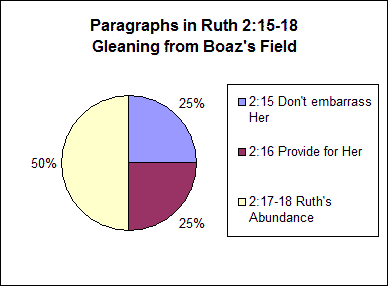
Verse Percentage Chart for Ruth 2:15-18
Please notice that
50% of this paragraph concerns “Ruth’s Abundance!”
Glad For Blessing: 2:19-23
“I Gleaned With Boaz” 2:19
“The Kinsman-Redeemer” 2:20
“Safety In Boaz’s Field” 2:21-23
INTRODUCTORY COMMENTS:
As you can see by the titles in the "Brief Outline" above, this paragraph is
mostly about the character and nature of Boaz.
As Ruth returned from gleaning in Boaz’s field, she will be confronted by Naomi
with all of the standard “Mother’s” questions. “Where, and with whom?” Her
questions should remind us of “Where, and with whom?” do we gather the Lord’s
blessings, or probably better rephrased as… “Where should I labor and with
whom?” in order to gather the Lord’s blessings. We need to inquire of the Lord
at every new opportunity – work, ministry, relaxation, family, and all other
kinds of areas of possible ministry and resulting blessings. Learning to “make
it all count” for Him – and the blessings will flow.
Blessing
#1:
“I Gleaned With Boaz”
2:19)
Her mother-in-law
then
said to her,
"Where did you glean today and
where did you work?
May he who took notice of you be blessed."
So
she told her mother-in-law
with whom she had worked and said,
"The name of the man with whom I worked today is Boaz."
Brief Commentary on Ruth 2:19
Ruth comes home to Naomi with her 25-30 Lbs. of grain and the special treat of
leftover roasted grain in a fine Olive oil and balsamic vinegar mixture. Naomi
wants to know "Who took notice of you today, girl?" No gleaner ever comes home
with 30 lbs. of grain and goodies to boot. Something very special has happened
in the field today and Naomi wants to know what it was. It is obvious to Naomi
that someone has placed a keen eye upon Ruth because of the heaped
blessing of all this excellent grain.
We don’t want to miss the author’s “So,” for it indicates Ruth’s willingness to
share her experience in Boaz’s filed, and does so without hesitation. This is a
good sign that Ruth and Naomi are continuing to trust and love each other – no
secrets here..
Ruth tells Naomi that she worked with Boaz – and Naomi must have nearly fainted,
The LORD has placed Ruth right into the notice of an available Kinsman-Redeemer
of Elimelech's family line – Halleluiah! And… He is obviously showing Ruth
special favors.
In the symbolism Naomi is the one who already has a longstanding relationship
with the LORD, even though she has been hurt in the last few years. She is in
desperate need for a Kinsman-Redeemer. She knows the truths of the grace and
goodness of the LORD. When she hears that Ruth has become the object of a
Kinsman-Redeemer's attention, she blesses him knowing that God has again
provided. If this works out the family line will continue.
Ruth tells Naomi about the owner of the field where she is gleaning. It is Boaz!
Naomi's response, based upon her knowledge of Boaz, – a close member of the
family – a candidate, rich and powerful and unmarried – is a blessing upon him
because she sees that "The Lord has not withdrawn his kindness to the living and
the dead."
How wonderful it is when someone for whom we have been praying comes to the
attention of The Master. How excited we should be to see this one who is
answering God's call and actively building a relationship to Him.
We should also not miss the word “With” when Ruth is telling Naomi about her
work. Ruth relates to Naomi that she has “worked with Boaz,” no “work for Boaz.”
Now, here at the end of the day, we see that Ruth has a growing attachment to
Boaz, like he has for her.
Blessing
#2:
“The Kinsman-Redeemer”
(2:20)
And
Naomi said
to her daughter-in-law,
"May he be blessed
of the LORD
who has not withdrawn his kindness
to the living and
to the dead."
Again
Naomi said
to her,
"The man is our relative,
he is one of our closest relatives."
Brief Commentary on Ruth 2:20
Naomi's response is the immediate recognition of God's blessing upon Ruth and
her, and in response calls out a blessing upon Boaz. She recognizes that God is
still active in their lives, and that He is still granting grace to her family.
Her statement here "to the living and to the dead" probably now means Ruth, "the
living," and herself "the dead" knowing that she is totally unable to take
advantage of the Jewish Levirate marriage law.
Naomi tells Ruth the good news – "He is one of our closest relatives!" However,
her statement also indicates that Naomi knows that he is only one of the closest
relatives. No matter how available Boaz might be, the law is related to the
closest male relative – not one of the closest." Intrigue enters the story as
Naomi hints of a possibility of a future forming problem.
The question comes up, “Why does the book of Ruth repeatedly bring up the theme
of the Blessings of God.? The character of God is family based [Father, Son,
Holy Spirit] [Adam, Eve, children] [Jesus, The church / Husband and Wife] etc.,
The Blessings of God are intended to be from generation to generation,
continuing down through the ages. In the large picture also is the – “He is the
God of the Living and the Dead.” He is the God, whom Abraham believed, who could
bring Isaac back to life if God has asked Abraham to really slay him. He is the
God who brings life from dead things. He is the God of living believers and
those who are spiritually dead.
Blessing
#3,
Part-1:
“Safety in Boaz’s Field”
(2:21)
Then
Ruth
the Moabitess
said,
"Furthermore,
he said to me,
'You should stay close to my servants
until they have finished all my harvest.'"
Brief Commentary on Ruth 2:21
This paragraph begins with the word “Then…” Our author wants us to be excited by
this revelation that Ruth adds, that Boaz told her to come back for the rest of
the harvest season and that it would be safest for her to stay close to the
servants – not mingle among the gleaners, or work the far ends of the fields
away from the servants.
Naomi probably jumped for joy at Ruth’s revelation. This man, who might become
her family’s Kinsman-Redeemer has certainly taken a liking to Ruth.
Ruth, once again, calls herself a Moabitess. While we might jump to the
conclusion that she doesn’t think that highly of herself in this Jewish society,
we need to remember that one of the main ingredients in the Book of Ruth is the
constant reminder that Gentiles (non-Jews) have been in God’s plan for personal
salvation from the very beginning. “Strangers,” were included in God’s Law for
Israel and their inclusion with the nation, and their being able to be
proselyted as Jews was clearly mandated.
The word “Furthermore,” as a phrase does not actually occur here. It has been
inserted by the translators of the NASB to indicate the still-continuing nature
of this conversation between Naomi and Ruth. It’s good to check the footnotes of
any translation to see what the translators add or remove to complete the
storyline.
When is it most dangerous for the one coming to Christ? When the evil one finds
out that this little one is on the straight path to Christ. "Stay close to my
servants," is Boaz’s warning. "Don't wander into the far corners of the field,
for it is dangerous there. It is indeed dangerous to wander too close to things
that are not of Christ. The evil one, the World, and the Flesh are always at the
ready to snatch away the seeker, and the new believer. "Stay close to my
servants, until the harvest is finished."
Blessing
#3,
Part-2:
“Safety in Boaz’s Field”
(2:22)
And
Naomi said to
Ruth
her daughter-in-law,
"It is good my daughter,
that you go out
with his maids,
lest others fall upon you
in another field."
Brief Commentary on Ruth 2:22
Naomi strengthens Boaz's words and elaborates on the dangers. While she is in
Boaz's field she is there as an invited guest, under the protection of the
Master. In another field she would be an intruder with no one to watch out for
her safety. Others, those not under the Master's discipline, might not be so
kind.
And the message to us is to stay away from the corners of His field
– those within the Body of Christ who hold extreme positions or positions that
are uncommon with good interpretation, good preaching, and good conscience.
Beware of the fringe element. Keep new believers and seekers away from these
"corners" of the Field. Instead keep them up close to the "workers" those who do
the work, for their knowledge, their fellowship, and their protection.”
Stay away from Other Fields. There should be a big sign on the way out of our
believing churches – "DON'T GO TO ANOTHER FIELD!" The meaning being, of course,
don't dabble in things that are not of Christ. Don't "toy" with Satan, or the
Flesh, or the World. They are deceitful and dangerous, taking many captive.
Blessing
#3,
Part-3:
“Safety in Boaz’s Field”
(2:23)
So
she stayed close by the maids of Boaz
in order to glean
until the end of
the barley harvest and
the wheat harvest.
And
she lived with her mother-in-law.
Brief Commentary on Ruth 2:23
Ruth heeds Naomi's and Boaz's advice. When at work she stays close, when she is
not at work she stays close to Naomi. There is something to be said for the one
who listens to good instructions and then does the right thing.
Our author mentions two grain harvests, both barley and wheat. The two harvests
happen at about the same time. In today’s world, with mechanization, a grain
harvest, on a small farm, only takes a couple weeks of labor. However,
generations ago, before mechanization, a simple grain harvest may take more than
a month. Cutting, reaping, gleaning, sheaving, drying, winnowing, storing, etc.
The process is lengthy and takes much labor.
Think of all the processes involved with the nation of
Israel getting their act back together to serve the Lord God. So many intricate
lessons and activities that make up the then Judean Jewish people returning to
fellowship and service with their God. Even now, in our world, as individuals
who have perhaps been disciplined by the Lord for sinful activities. it can be a
long and complicated process in re-establishing lives with the Grace of God and
how it often takes good instruction for more mature believers along the way. May
that mature believer be you as you open your arms and help those who wish and
desire to return to the Lord’s calling. Meetings filled with coffee and the
bible, general fellowship, and the sharing of God’s love and grace. That’s how
you can be a part of God’s plan for the restoration of God’s wayward children.
Naomi then tells Ruth to go back to the same fields and work with Boaz's
servants until the end of the harvest season – Go Back and Spend Time with Them
(HIM)!
Verse Percentage Chart for Ruth 2:19-23

Ruth’s safety is
forefront here.
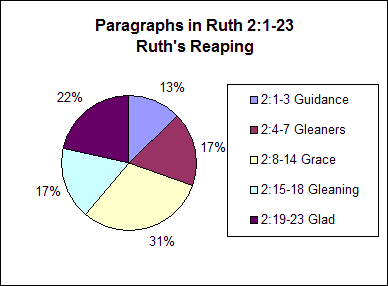
The Whole Chapter 2
Chart
And for the
whole of Chapter 2 – Grace is the Key Feature.
The Book of Ruth Bible Study materials on this
website are a ministry of AncientPath.net and are made available here free and
may be copied for use in Bible study groups, in limited numbers, providing that
no charge is made for them. Items that appear as copyrighted materials that are
not of our authorship are not to be copied without the express permission of the
original copyright holders. Every effort has been made to give proper footnote
credit for items that are quoted.
No further distribution or use of these materials is allowable under U.S. or
International Copyright Law without the express permission of AncientPath.net.
©2008
AncientPath.net, All rights reserved.
J. Deering [AncientPath.net]
is the author and editor of this study.
AncientPath.net © 2024
Jeremiah 18:15
"Don't stumble from the Ancient Path.”
2024-05-15 update
2024-05-15 Original Class Date
2025-03-28 update