
|
The
Book Of Ruth |
Chapter
2:4-7
"Ruth's Reception"
J. Deering, AncientPath.net
Download Study -
BACK TO RUTH - GROUP STUDIES
HOMEPAGE -
BACK TO AncientPath
HOMEPAGE
LESSON 06
The Book of Ruth - CH-2:4-7
"Gleaners in Boaz's Field"
INTRODUCTORY COMMENTS:
Along the way
we’ve been interchanging three words of “State” that you may find confusing.
First is
“Israel”
Israel is the
name given to the Hebrew people as a
nation. Abram was renamed Abraham. He had a son named Isaac, and he had a son
named Jacob, and God renamed him “Israel”. So, the family lineage that follows
was to be known as “Israel”.
Second is
“Judah”
Judah is the
name of the family tribe of Jacob’s
son Judah. That is the family line from which the Messiah would be born, as well
as King David.
Third is
“Judea”
Judea is the
place where the people of Judah
lived. A tribal territory given by Moses when they were going to enter into the
“Promised Lands” that God had promised Abraham for his family’s inheritance. Two
tribes received land East of the Jordan River and the other 10 to the West of
the Jordan (Joshua 13-14).
Quick
history… (mostly accurate)
Following King David there was a civil war and Judah and Benjamin remained
mostly faithful to the Lord. They occupied Judea upon the split. The other 10
tribes who did not remain faithful kept the name “Israel” and they were in the
North and were taken captive by the Assyrians. As Judea became more and more
unfaithful, God once again, exercised His discipline and both the Assyrians (who
had taken Israel captive) and Judea were taken away by the nation of Babylon to
the country of Babylon (Iran) in captivity. Upon their return, many years later,
released by the Persians (another conquering nation), they occupied Jerusalem
and Judea in general. The Hebrew “Israelites” became Judean, and then “Jews.”
“The Field of Boaz”
Addendum 02
The Book of Ruth: The Field of Boaz
Theme: John 14:2-3 “I have
to go and prepare a place for you.”
IN Ruth 2:2…
And Ruth the Moabitess said to Naomi,
"Please let me go to the field and glean among the ears
of grain after one in whose sight I may find favor." And she
said to her, "Go, my daughter."
God’s
Providential Hand brings Ruth to Boaz’s Field.
The following
observations are to be understood on at least 3 levels.
1.
The story of the lives of Ruth and Boaz, just as
they are reported in the book
2.
The imagery of the characters and the Nation of
Israel
3.
The imagery of the characters and members of the
Body of Christ
Each of these three levels can also be divided
into different important categories.
A.
The Story of the characters
of the book and their representations of the bigger story.
1.
Elimelech – Jewish man who makes the decision to leave “Judah” and move
to neighboring idolator land of Moab, forsaking God’s
Abrahamic Covenant to the land, and dies there.
2.
Naomi – Often seen as the “God” character in her manner of providing for
and testing Ruth.
3.
Mahlon and Kilion – Two Jewish sons, Judean men who married pagan women
and worshipped their idols and died in Moab.
4.
Mahlon’s wife Ruth – The secondary central character of the book who
represents the one who repents and seeks the Lord God through commitment to Him.
5.
Kilion’s wife Orpha – She is seen as the one who is introduced to the
Lord God but turns back to her pagan life.
6.
Elimelech, Mahlon and Kilion’s deaths leaving their wives leaving them
indigent in a foreign land.
7.
Boaz – the central character to the book. He is the Kinsman-Redeemer that
will continue the family line to King David and The Lord Jesus.
8.
The closer relative – a Kinsman-Redeemer who refuses to act according to
Jewish tradition in providing “redemption” of a widowed woman family member.
B.
The imagery of the
characters representing the Nation of Israel
1.
Elimelech – Jewish men who abandon their covenanted nation in order to
find satisfaction for their needs when the Lord God brings discipline upon them
and their families – especially by turning to pagan lands and people to bring
that satisfaction.
2.
Naomi – The believing wives of the men who upon their chastisement and
deaths repent and turn to the Lord God bringing other lost souls with them.
3.
Mahlon and Kilion - The men of God’s Covenanted people who seek “foreign”
women and are taken into Idol worship by them, and chastised by the Lord God,
many to their deaths.
4.
Orpa and Ruth – Two Pagan women who have been found and married by Jewish
men. Both will be offered belonging to the Lord God. One will repent and choose
the Lord God, and one will not. “One will be taken, and one will be left.”
5.
The Closer relative – Jewish men who have turned away from their Covenant
responsibilities in order to avoid commitment.
6.
Boaz – The Kinsman-Redeemer, the one who voluntarily chooses to continue
the family line of a Jewish man who loses his life and leaves his wife with no
male in her family to continue the original husband’s family name as part of the
nation.
7.
The Workers - The Remnant, those in the nation who have remained
faithful to God.
8.
The Field - The believing nation of Israel.
9.
The Harvest - The calling out and gathering of the Believing
members of the Nation of Israel.
C.
The imagery of the characters representing the Members of the Body of
Christ
1.
Elimelech, Mahlon, Kilion – The believer who abandon’s his Christianity
in order to fulfill his personal needs or one who embarrasses the Body of Christ
in such a way that his life must be taken to stop it (Ananias and Sapphira –
Acts 5).
2.
Ruth – The Bride of Christ – all those who leave the love of this world,
idols, distractions from God’s grace, and openly, willingly, voluntarily
choosing The Lord Jesus as their Kinsman-Redeemer. Our substitutional personal
sacrifice for the forgiveness of sins, our justification before The Lord God,
and our provider of The Lord’s God’s Grace and Salvation.
3
Boaz – The Lord God Jesus the Christ – Our Kinsman-Redeemer.
4.
The Workers - The believing members of the local church.
5.
Boaz - The Kinsman Redeemer - Jesus Christ.
6.
The field - The bounty of God’s grace and the Word of God.
7.
The Harvest - The calling out and gathering of the Body of Christ
It is important
to know that the imagery of the book can be used in seeing the restorative,
reconciling, redemptive nature of God.
Our focus will
be two-fold. First is the restoration to fellowship with God of the
disobedient child of God. In the book of Ruth, we see the nation of Judah
(Israel) in the process of being welcomed back form her sin of idolatry in
allowing many of the men to take foreign Godless wives who turned the nation
against the Lord. The nation repented (turned around) through the chastisement
of famine and once again sought their living God (Ruth 1:1-22). Beginning in
chapter two we can see the imagery of repentant Israelites (Ruth) in the process
of returning to her God (Boaz) by going to His field and approaching the
"reapers" (the Hebrew word translated here as "reapers" only indicates that
those Ruth approached were "followers," or "the remnant.") Those who did not
disobey God and did not leave His will. Within this first focus we can also see
the Grace of God for the believer who has sinned, confessed his sin, and is in
the process of reconciliation and restoration in the fellowship of God (1 John
1:9 ff).
The second
area of focus would be in seeing the imagery in terms of those who have not
begun their relationship with God but have been called by Him (as Ruth is being
called). The story then becomes the romance of God toward the one who approaches
for Salvation whether it is a member of the Nation of Israel in Ruth's time (in
Ruth's case a proselyte Gentile) or a Jew or Gentile seeking Him for salvation
today.
Be careful when
you read and apply each of these focus ideas that you do not confuse them. Ruth
was probably included in the O.T. canon because of its parallel imagery
concerning the Nation of Israel and its cycles of fellowship VS judgment
throughout the book of Judges. The book is primarily about Restoration and
Fellowship with God, not the salvation of the individual.
THE VISUALIZED TEXT
(NASB)
(2:4)
Now
behold,
Boaz
came
from Bethlehem and
said
to the reapers,
"May the LORD be with you."
And
they said
to him,
"May the LORD bless you."
Brief Commentary on Ruth 2:4
It is remarkable
how gracious the call of God is when you answer it and seek Him. Chapter 2 is
all about Boaz's grace toward Ruth as she begins the journey toward Him.
In Chapter 2:4-7
we are introduced to Boaz. He is a man of wealth and property. He is also seen
to be a man of not only grace but also of a heart to keep the law, especially
where the poor are involved. At a time when many farmers closed themselves off
to "the law of the poor" that allowed the poor and the stranger to have access
to the harvest, Boaz is seen to be a landowner who is not surprised to find
gleaners in the field with his workers. It is his common practice to make sure
that those who have come under the law to find sustenance are allowed to do so
in his fields.
Ruth has come to this field, she has
asked for, and received, permission from the overseer to glean, and she has been
diligent in the gathering of grain for herself and Naomi.
"Now
behold" introduces us to this verse
and adds a little excitement to the plot. Behold… this sounds like a rare
occurrence… the master who owns this field has actually come out (from the City
of Bethlehem) to the fields to meet his workers and those who are poor and glean
behind the workers. Ruth has asked for and received permission to glean – from
the field supervisor, but not the owner. Now that she has been there gleaning
for most of the day the owner arrives on the scene. He has come down from the
city to review the fields and the workers.
Our introduction to Boaz tells us that he is a faithful
man of the LORD God and that he is gracious to his workers.
"May the LORD be with you," he
says to the workers. We can also see a sign of their respect for Boaz, as they
reply to him, “Jehovah, Bless.” This is very similar to our own, “May the LORD
be with you,” and the replay, “May the LORD Bless You.”
Boaz is a "mighty man" who has come
to the fields to give the workers the blessing of God upon their lives and work.
We could expect the master on his horse with a whip, or a master leading a
company of tough guys to bring order and more work out of the fields and the
field workers. But instead, we are presented with a man of God who is at the
first interested in his workers and the welfare of those who are less fortunate
(the foreigner and the poor) who must resort to gleaning the leftovers.
When we see Boaz as the symbol of
God in this text we get a glimpse into His grace. His interest lays in the
workers of His field (those who know Him and are about His business) and those
who have been drawn into His field to find not only His sustenance, but also to
find Him.
Boaz's workers are also to be recognized for their grace
toward their master (in blessing him) and for their grace toward Ruth and any
others who have come to glean by extending permission (in the Master's name) to
them to glean.
It’s interesting that the background
of the meaning of a “Blessing” is rooted in the word for “kneel,” and is most
often linked to the idea of adoration.
(2:5)
Then
Boaz said
to his servant
who was in charge of (Lit., who was
appointed over) the reapers,
"Whose young woman is this?"
Brief Commentary on Ruth 2:5
We see order in the operation of
Boaz's field. There are grain cutters, reapers, bundlers, and supervisors for
each group. Some sow, some water, some reap. There are so many parallels between
the truths of the Old Testament and the New.
Boaz wants to know, "whose young
woman is this?" Perhaps we should add, “Behold!” He has seen her and must know
more. She is probably quite beautiful, she's young, she has come alone and must
be brave, she has come on Naomi's behalf and must be faithful, she has come and
worked all day and must be diligent, and she has come to this field for
sustenance, and she must be hungry.
In the larger imagery of Ruth
(representing the one who is called by the LORD God and is responding to His
call) therefore is quite beautiful to Him, she is quite young in Him, her faith
has brought her to Him alone, she has bravely overcome the stubborn human will
that is against Him, she has come to His presence because she is hungry for Him.
(2:6)
And
the servant
in charge of
(Lit., who was appointed over)
the reapers
answered and said,
"She is the young Moabite woman
who returned
with Naomi
from the land
of Moab."
Brief Commentary on Ruth 2:6
Boaz's servant or field supervisor has all the information on this one who has
come to his field to glean. It's Ruth, the stranger in Judah, (again singled out
as a foreigner) the Moabite who came with Naomi when she returned to Bethlehem.
Naomi, who is the mother of the late Mahlon, who is the son of Boaz’s close
relative Elimelech who has also passed away. “Oh, that’s Elimelech’s son’s wife,
Ruth.”
(2:7)
"And
she said,
'Please
let me
glean and gather
after the reapers
among the sheaves.'
Thus
she
came and has remained
from the morning until now;
she
has been sitting
in the house
for a little while."
Brief Commentary on Ruth 2:7
The servant continues his dialog
about Ruth. She asked permission to glean, and she asked specifically to glean
right behind the reapers – there among the sheaves – and not way in the back
where the field has already been picked over. She came this morning and has
worked all day and only now takes a break.
Those who are returning to the Lord (repentance) or
coming to Him for the first time (salvation) would do well to learn from Ruth.
Come, ask, work hard at gleaning God's truth and character, and be diligent in
your exercise of faith. Make sure you remain close to Him and His Word.
Some quick Field definitions:
Reaper
– Those women who follow the male cutters of the grain. Their job was to gather
and bundle the cut grain.
Sheaves – Bundled stalks of grain,
usually a measured amount – the Omer.
“Among
the sheaves” – Picture the harvested field with bundles of grain setting in
rows waiting to be picked up and moved to the barns for winnowing and storage.
Being among the sheaves is a beautiful picture of the work being done in the
field.
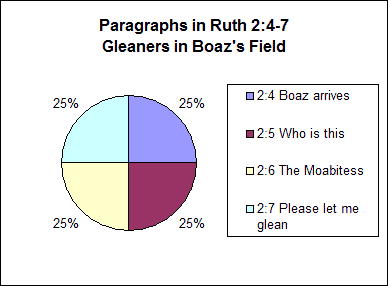
Verse Percentage Chart for Ruth 2:4-7
Download Study - BACK TO RUTH - GROUP STUDIES HOMEPAGE - BACK TO AncientPath HOMEPAGE
The Book of Ruth
Bible Study materials on this website are a ministry of AncientPath.net and are
made available here free and may be copied for use in Bible study groups, in
limited numbers, providing that no charge is made for them. Items that appear as
copyrighted materials that are not of our authorship are not to be copied
without the express permission of the original copyright holders. Every effort
has been made to give proper footnote credit for items that are quoted.
No further distribution or use of
these materials is allowable under U.S. or International Copyright Law without
the express permission of AncientPath.net. ©2008
AncientPath.net,
All rights reserved.
J. Deering [AncientPath.net]
is the author and editor of this study.
AncientPath.net © 2024
Jeremiah 18:15
"Don't stumble from the
Ancient Path.”
2024-05-01 Original
Class Date
2025-03-28 update