|
The
Book Of Ruth |
Chapter
1: 19-22
"Ruth's Reception"
J. Deering, AncientPath.net
Download Study -
BACK TO RUTH - GROUP STUDIES
HOMEPAGE -
BACK TO AncientPath
HOMEPAGE
LAST WEEK:
Ruth's Return 1:11-18
1.
Daughters-in-law Directed: 1:11
But Naomi said, "Return, my daughters to your families.
2.
Discouragement: 1:12
"Return, my daughters! Go, for I am too old to have a husband.
3.
Despair: 1:13
Naomi: “for the hand of the LORD has gone forth against me."
4.
Departure: 1;14a
And they lifted up their voices and wept again; and Orpah kissed her
mother-in-law… and left.
5.
Devotion: 1:14b
but Ruth clung to her.
6.
Desire: 1:15
Then Naomi said to Ruth, "Behold… return after your sister-in-law."
7.
Dedication: 1:16-17
But Ruth said, "Do not urge me to leave you or turn back from following you; for
where you go, I will go, and where you lodge, I will lodge. Your people shall be
my people, and your God, my God. 17 "Where you die, I will die, and there I will
be buried. Thus, may the LORD do to me, and worse, if anything but death parts
you and me."
8.
Determination: 1:18
When she saw that she was determined to go with her, she said no more to her.
THE BOOK OF RUTH – CH-1:19-22
RUTH’S RECEPTION
First, we have a quick
summary of the previous lessons.
The Prophet Samuel is thought to have written Ruth but there is no absolute way
to know. If it was Samuel, he would have been born some 15 years after the
events of the book. He died sometime after the coronation of King David (about
1003 BC) some seven years after David had become king of Judah. That places him
in his late seventies or early eighties during the time of the writing of the
book. Whoever it was that wrote the book did so with a very special purpose:
Show all of Israel the Character of God and His mighty works in keeping the
nation of Israel in His fellowship and care and use a true family story to tell
it.
Many conservative scholars see the plan of God for maintaining fellowship with
Israel as the central key to the book. The lives of the family members of the
book closely follow the historic dealings of God with the nation of Israel. We
also see a similar pattern in the way God, through the Lord Jesus Christ, so
wonderfully loves, corrects, and restores fellowship to the members of the Body
of Christ.
In the first paragraph of the book (1:1-5) we are introduced to our first
parallel. The people of Judah have wandered away from God and taken on Idolatry.
This was accomplished, in part, by the men taking foreign wives and the
influence of their gods. Probably just a few at first, but so many became
involved in this practice that the whole nation was to become accountable for
it. Here in these verses, we are introduced to a family who will portray the
actions of Judah in the story.
We should note here that the story was not written to accomplish this by the
human author. The probable scenario would be that the story of Ruth as told
orally, or by that time written down, and was noticed by our author as having
these wonderful parallels in it. The story, as we know it, was remembered, and
“published” probably for the coronation of King David when he became King of all
Israel in order to “bring to remembrance” all that God had done for Israel in
keeping her as His own. It may have also served to verify the kingly family line
of David.
At the beginning of the story Elimelech, his wife and two sons, who live in “The
Promised Land” are leaving there and go to Moab to seek the provisions of life.
There is famine in Judah – caused by God’s chastisement for the nation’s leaving
Him and taking the women and Idols as their provisions of life – and not
trusting God and turning to Him in their time of need. While there the sons take
Moabite women as wives. Elimelech and his two sons die in Moab just as many who
have acted against God have died in the famine in Judah.
In the second paragraph of the book (1:6-10), 10-15 years later, Elimelech’s
wife (Naomi) and two Moabite daughters-in-law (Orpah, and Ruth) consider
returning to Judah because “God has visited His people” with food. The parallel
here is that the Nation of Israel, in one of her many cycles of disobedience,
recognizes that it is God who is chastising them and they in turn begin
returning to Him.
In the next paragraph (1:11-18) the imagery has shifted from Elimelech and his
two sons (now dead) to Naomi and her dilemma. She now is indigent and seeks to
return to Judah (the nation realized that without God they have nothing). Naomi
seeks to go home but has two Moabite women in tow (as the nation turns from
idolatry, they must still deal with all the foreign wives which they have
accumulated). Naomi knows that they have been a great influence on her family as
far as foreign gods are concerned and she devises a series of tests to make sure
that only those (Ruth) who seek The Lord God would enter the “Promised Land.”
Just as the Israelites knew that God would never allow their return to Him if
they carried Idols of the foreign gods in their hearts. The result is that Naomi
has winnowed the chaff away (Orpah) and only Ruth remains – “Where you go, I
will go, and where you stay, I will stay. Your people will be my people and your
God my God.”
In this paragraph (1:19-22) we see Naomi returning to Bethlehem, Judah. She has
come with a contrite heart willing to be humble before the people of the city.
The parallel here is when the nation finally makes its decision to return to
God, in each of her cycles of rebellion, it must do so confessing to God that
once they had everything when they had Him, and now they have nothing without
Him. It should be noted also that Naomi returns with the Moabitess (Gentile)
Ruth who is now a faithful believer in The Lord God. Through this imagery we can
see that when the nation returns from their backsliding pagan endeavors, they
will return with gentiles in tow that have believed due to the presence of Godly
Hebrews in their midst. Even though the Israelites did not see the importance of
it at the time, God has always had a place for Gentiles who sought to believe in
Him and Him alone. One should consider Melchizedek – a Priest of the Most High
God, whom Abraham brought tithes – before the nation of Israel even existed, as
did thousands of generations of people before him.
Ruth
1:19-22, Ruth's Reception
THE VISUALIZED TEXT:
(NASB)
(1:19a), Naomi and Ruth’s Sojourn
So
they both went
until they came to Bethlehem.
Brief Commentary on Ruth 1:19a, Naomi and Ruth’s Sojourn
Our verse begins with the
word, “So.” This indicates another quick shift in our plot. A new bond has been
made. Naomi and Ruth are now a single-family unit and they both respond to the
call of God to return; return to Naomi’s Bethlehem-Judean family; return to the
Land of Naomi’s ancestors; and return to Naomi’s God (The Lord God of Israel).
So, they went to
Bethlehem. They did not stop short or go further.
(1:19b), Naomi’s Surprise
And
it
came about
when
they
had come to Bethlehem,
that
all
the city was stirred
because of them, and
the women said,
"Is this Naomi?"
Brief Commentary on Ruth 1:19b, Naomi’s Surprise
We should not miss the
emphasis on the city of Bethlehem
Ephrathah,
the birthplace of King David, and the birthplace of Our Lord Jesus Christ.
We should notice that in
this verse (1:19 a & b) the city of Bethlehem is mentioned twice – What I
learned a long time ago was… When God speaks twice about the same thing… you
should listen carefully!
As Naomi and Ruth return
to the city of kings … Israel has begun to turn back to God her King. We as
believers in Jesus the Christ sometimes need to turn around (repentance) and
confess our sin and return to The King of Kings.
“Oh My!” the women of Bethlehem said. “Look there is Naomi – she looks
terrible!” Naomi had left Bethlehem “full,” joyful, and proud. Now she returns
indigent, worn, beaten up by life, dejected, joyless, bereft of her husband and
sons – and she has a Moabitess with her. “Is this Naomi?” they ask, hardly
recognizing her. Ten to fifteen years have passed, and life has been hard on
her. This once proud and well-known family has been reduced to Naomi and a
foreigner.
(1:20a), Naomi’s Sorrow
And
she said to them,
"Do not call me Naomi (i.e.,
"pleasant");
call me Mara
(i.e., "bitter"),
Brief Commentary on Ruth 1:20a
Many commentaries say
here that Naomi returns angry and bitter. I don’t think that’s the whole story.
I see a woman of God at the end of His chastisement and discipline returning
(having repented from leaving Him and His provisions, having turned around) and
coming back to Him. She’s saying, “I was misnamed.” For I went out “full of
myself,” and now through His chastisement, I come home knowing who I really am.
I am nothing before Him. “Don’t call me pleasant," “Call me bitter!” She has
been undone.
(1:20b), Naomi’s Situation
for
the
Almighty
(Heb., "Shaddai")
has dealt very bitterly
with me.
Brief Commentary on Ruth 1:20b, Naomi’s Situation
How many of us have been
chastised by the Lord only to return to Him bitter. We often go our own way,
like the Israelites during the time of the Judges, doing what we think is
justified because we want it so badly. He chastises us when we take life into
our own hands - sometimes He breaks us (the Shepard’s Rod, Psalm 23), and often
we return to Him bitter for it. Naomi acknowledges that it is the Almighty that
has done this, and she acknowledges that she has been bitter before the Lord and
He has chastised her for it. She has been in the valley between the mountain
tops of blessing. But, she calls her God, ‘El Shaddai,’ the almighty God – and
she is returning to Him.
(1:21) Naomi is Sorry, P-1
"I went out full,
but
the LORD (Heb., "Shaddai")
has brought me
back empty.
Why do you call me Naomi,
Since
the LORD
has witnessed against me and
the
Almighty
has afflicted me?"
Brief Commentary on Ruth 1:21, Naomi is Sorry, P-1
“Once full, now empty”
but, she says “the LORD,” again ‘El Shaddai,’ brought me back. It is “the LORD”
who witnessed against me,” it is “the LORD” who has afflicted me. There is
something to be said for Naomi who genuinely recognizes that it is the Lord who
has done this. She doesn’t blame the weather, Moab, Elimelech, or Ruth for this
discipline. Instead, she sees that it is from the Lord. So too does the Nation
of Israel return to their God recognizing that it is He who has done these
things (famine) – for their own good – that they, the nation, might cling to
Him, return to Him, and Him alone.
The believer should
always remember that all things are under The Lord’s control. When life is at
its worst it is best to consider that maybe you are in need of these things, or
maybe He is using you to teach faith to others. Whichever it is, He is in
control, and He is shedding grace upon you all the way, and in everything – even
if we don’t like it at the time.
(1:22), Naomi is Sorry, P-2
So
Naomi returned, and
with her Ruth
the Moabitess,
her
daughter-in-law,
who returned from the land of Moab.
And
they came to Bethlehem
at the beginning of barley
harvest.
Brief Commentary on Ruth 1:22, Naomi is Sorry, P-2
The writer sums up
Chapter One. Now the story will turn to “The Redeemer.” Naomi has
returned (Israel has returned) with the Moabitess Ruth (Israel and her foreign
wives of idolatry), now in a family relationship with each other, and they have
come to Bethlehem (returned under the authority of the King) at the beginning of
the barley harvest – the fields are ripe for the harvest. The Redeemer is
waiting! It is now 50 days after Passover. The Barley harvest is the last
harvest before Pentecost.
The Book of Ruth
“The Feast of Weeks”
The
Feast of Weeks celebrated at the end of 7 weeks (50 Days) Called Pentecost (50
days)
1.
The
Nation of Israel waits for the "Man of Salvation."
2.
Ruth -
The Book of the "Kinsman Redeemer."
3.
Feast
also called The Feast of Harvests - it concluded the harvest of the latter
grains (the last harvest)
4.
God’s
Last Harvest of the Nation – After this, The Gentiles and Jews Through The
Christ
5.
The
feast of First Fruits - The first loaves of bread at Pentecost are made from the
Last Harvest and were offered on the Altar – Christ is offered on the Altar of
the Cross.
6.
Christ
and The Apostles as the First Fruits of God’s Last Harvest
7.
Acts
2:1 - At Pentecost
8.
Acts
2:9 - Those who were there – Jews and Gentiles who turned around.
Acts
2:36-41 - What happened there – Rejoicing as a new family
This was a feast of Rejoicing -
Men,
women, children, servants, Strangers and specifically Widows, The Poor, and The
Orphaned
The Preparation:
For
the Jew
1.
The
Confession of Sins
2.
The
Repentant Heart
3.
The
Immersion of Water Baptism
4.
The
Dressing in Festive Garments
The Celebration at Sinai:
1.
After
Sundown Beginning with the Fiftieth Day after Passover.
2.
Prayer
- The Glory of the Law Giver (God).
3.
Prayer
- The Glory of Israel.
4.
The
Hallel - Exodus 19:1-20:26 The giving of the law that God’s people might know
His character and know Him.
Israel, freed from Egypt, enters the
wilderness of Sinai and camps at the Mountain. Moses leaves them and goes up to
the Lord on the mount. The Lord tells Moses to tell the people, “You
yourselves have seen what I did to the Egyptians, and how I bore you on eagles’
wings, and brought you to Myself. Now then, if you will indeed obey my voice and
keep My covenant, then you shall be My own possession among all the peoples, for
all the earth is Mine; and you shall be to Me a kingdom of priests and a holy
nation.”
Then God spoke all these words saying,
“I am the Lord your God, who
brought you out of the land of Egypt, out of the house of slavery.
You shall have no other gods before
Me.
You shall not make for yourself an idol, or any likeness of what is
in heaven above or on the earth beneath or in the water under the earth. You
shall not worship them or serve them; for I, the Lord your God, am a jealous
God, visiting the iniquity of the fathers on the children, on the third and the
fourth generations of those who hate Me, but showing lovingkindness to
thousands, to those who love Me and keep My commandments.
You shall not
take the name of the Lord your God in vain, for the LORD will not leave him
unpunished who takes His name in vain.
Remember the sabbath day, to keep
it holy. Six days you shall labor and do all your work, but the seventh day is a
sabbath of the Lord your God; in it you shall not do any work, you or your son
or your daughter, your male or your female servant or your cattle or your
sojourner who stays with you. For in six days the Lord made the heavens and the
earth, the sea and all that is in them, and rested on the seventh day;
therefore, the Lord blessed the sabbath day and made it holy.
Honor your
father and your mother, that your days may be prolonged in the land which the
Lord your God gives you.
You shall not murder.
You shall not
commit adultery.
You shall not steal.
You shall not bear false
witness against your neighbor. You shall not covet your neighbor’s house; you
shall not covet your neighbor’s wife or his male servant or his female servant
or his ox or his donkey or anything that belongs to your neighbor.”
And also:
5.
The Reading of the book of Ruth.
6.
The
Maphir - Numbers 18:26-31 The Tithe of the Tithe - the offering of the Believer
Priests.
7.
The
Lesson from the Prophets - Ezekiel 1:1-3:12.
8.
The
Musaph - The Evening Prayer.
9.
The
Benediction - Deuteronomy 15:19-16:7, Habakkuk 2:20-3:19.
Ruth 1:19-22 "Ruth's Resolve" Paragraph Verse Percentage Chart
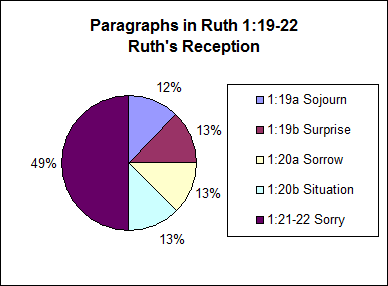
This
last paragraph, “Ruth’s Resolve” is overwhelmed by Naomi’s admission of her
“Sorrow” (repentance) to the Lord as she returns to Him and His nation of
Israel.
The Book of Ruth
Bible Study materials on this website are a ministry of AncientPath.net and are
made available here free and may be copied for use in Bible study groups, in
limited numbers, providing that no charge is made for them. Items that appear as
copyrighted materials that are not of our authorship are not to be copied
without the express permission of the original copyright holders. Every effort
has been made to give proper footnote credit for items that are quoted.
No further distribution or use of these materials is
allowable under U.S. or International Copyright Law without the express
permission of AncientPath.net. ©2008
AncientPath.net, All rights reserved.
J. Deering [AncientPath.net]
is the author and editor of this study.
AncientPath.net © 2024
Jeremiah 18:15
"Don't stumble from the Ancient Path.”
Original Class Date: 2024-04-24
2025-03-28 update