|
The
Book Of Ruth |
Chapter
1: 6-10
"Ruth's Resolution"
J. Deering, AncientPath.net
Download Study - BACK TO RUTH - GROUP STUDIES HOMEPAGE - BACK TO AncientPath HOMEPAGE

LAST WEEK:
We introduced the major characters of the Book of Ruth and their journey from Israel to Moab. Here’s our outline and text for what we covered.
I. Chapter 1:1-22
A. Ruth's Relationships 1:1-5
1. Statesmen: Judges Ruled 1:1,
2. Sojourn to Moab: 1:1-2 Now it came about in the days when the judges governed, that there was a famine in the land. And a certain Hebrew man of Bethlehem in Judah, Israel, went to sojourn in the land of Moab with his wife and his two sons. 2 And the name of the man was Elimelech, and the name of his wife, Naomi; and the names of his two sons were Mahlon and Chilion, Ephraimites of Bethlehem in Judah. Now they entered the pagan land of Moab and remained there.
3. Sorrow in Moab: 1:3-5 Then Elimelech, Naomi's husband, died; and she was left with her two sons.
4. Sisters-in-law: 1:4a The Sons, Mahlon and Chilian took for themselves Moabite women as wives; the name of the one was Orpah and the name of the other Ruth.
5. Stay in Moab: 1:4b and they lived there about ten years. 5 Then both Mahlon and Chilion, Naomi’s sons, also died; and the woman was bereft of her two children and her husband.
6. Sustained Sorrow in Moab 1:5 Then both Mahlon and Chilion also died; and the woman was bereft of her two children and her husband.
Now we will be moving into Chapter 1 and verses 6-10… but first some more introductory information.
We want to keep stressing our three applications of this book. First is the beautiful story of Ruth and Boaz, second is the parallel imagery that reflects the relationship between God and His people Israel, and thirdly the parallel imagery that reflects the relationship between God and His believers in this age of The Church.
Chapter one will set the stage for the main theme of the book – Redemption by the Kinsman Redeemer. In chapter one we have the people of God living in the "Promised Land" and they are deep into the chastisement of God (famine) for not keeping His commandments, especially the first two –
“I am the Lord Your God:”
1. “You shall have no other gods before me.”
2. “You shall not make for yourself an idol.”
The book of Ruth Chapter One is a complicated chapter that has, in its roots, the sad story of a family who chooses to “walk away” from God during a time of adversity. Doing so, especially today, is not always wrong. But for Elimelech and his family… they were God’s Covenanted (contracted) people specifically given the Promised Land.
This chapter of the story is broken down into four main paragraphs which are made up of twenty-four individual verses.
The first paragraph (1:1-5 [lesson 1]) introduced us to the “times of the Judges.” A dark age in the history of Israel when “everyone did that which was right in his own eyes,” instead of nationally turning back to God. Because of this, God brought “Judges” or dictators into the lives of the Israelites to deal with their wayward hearts and stiff necks.
A great famine had overtaken the nation, most likely brought about by the Midianites (they lived in the area of Sinai then considered part of Egypt) and they most likely salted the land and aggressively warred with Israel over several years (Judges 6:3-4).
A man, Elimelech, and his family, decide that the Hand of The Lord is too hard upon them, and they forsake Him and their country to satisfy their needs. They have chosen to sojourn (go for a short time) to the land of Moab. This is the land where their distant cousins settled (cursed because of incest), They were descendants of Lot through his son Moab – the Moabites.
After getting established in their new life Naomi’s husband dies and that leaves her and her two grown up male children alone in Moab. The young men forsake their Israelite heritage, and the Law of their God, and marry foreign wives (gentile idolaters) from Moab. After ten years of married life both husbands also die leaving these three women on their own alone in pagan Moab.
In the background of this story there is a possibility that a physical descendant of Elimelech could be the Messiah. This would be true of all the male descendants who continue in the family line. This is an unknown possibility to the family members, but the careful documentation of Matthew and Luke shows it to us.
At this point in their story, we should understand that with the death of Elimelech, Mahlon, and Chilion, the then possible physical line to the Messiah through Naomi to David had become broken. We should consider this a very important time in history when the evil one has caused, what seems like, the destruction of prophesy – the promise given to Abraham has seemly been broken, and the promised Messiah cannot come. But God has a better plan already in place and at work. What is not so evident is that the royal line through another relative is possible through a very special Hebrew arrangement, the Levirate marriage. An arrangement where an unmarried family male relative can marry the wife of a man who has died and left her with no continuing family line. In the book of Ruth, there is no levir (no male son) left, and Ruth’s father-in-law has died. But Boas, a kinsman of the family, marries Ruth and buys the property of her former husband’s family, whereby the law of redemption (Hebr. go’el) from Leviticus 25:25–28 plays a role, so that this house will endure in Judah.
Now, as we enter the second paragraph of the book (1:6-10), Elimelech’s wife, Naomi, and the two son’s wives, Orpah and Ruth, are now in the in unenviable position of having no money, no inheritance, and no property (except whatever Naomi owns outright). When things seem at their darkest, they hear that “The Lord of Israel has visited His people in giving them bread (food).” Here we also note the length of the famine in Israel (10 or more years). Naomi determines that it is time for her to return to her country and her people – even though she will be as indigent there as in Moab.
The Book of Ruth – CH-1:6-10 The Study
“RUTH’S RESOLVE”
INTRODUCTORY COMMENTS:
As we transition from the first paragraph to the second, we should spend a moment considering the bigger picture of the book of Ruth. God loves His people. In the Old Testament, since the time of God’s covenant with Abraham, it was the family of Abraham through Isaac and Jacob, and on to the twelve tribes that came out of Jacob, that God chose to be His “chosen” people. Later on it is revealed that the Messiah will come through the Tribe of Judah, and specifically be born in Bethlehem-Judah. In the New Testament, God sets aside the nation of Israel for a time and calls out to Himself a people we know as “the Church,” or “the Body of Christ.” The Book of Ruth sets forth pictures in words using Elimelech’s family, especially Boaz and Ruth, as types (or symbols) of God’s people (first the nation of Israel and then the Church). In the First five verses of the book, we see a picture of God’s family during the times of the Judges, when “everyone did right in his own eyes.” This was a time when God’s people turned their back on Him and worshipped pagan idols. The picture seen in the first five verses is of God’s people moving away from His promised land in the midst of famine because they were caught up in idolatry. The punishment by the hand of God is the loss of rebellious lives who have taken on foreign wives.
Turning to the second paragraph (1:6-10), we see the recognition that the Lord has shed His grace once again upon the Promised Land and his wayward people turn and seek Him and His grace.
A title for the first five verses of Ruth (1:1-5) would be “Ruth’s Relationships.” This new paragraph (Ruth 1:6-10), deals with the aftermath of the death of Naomi’s two sons, Mahlon and Chilion.
Naomi hears that, back in Judah, the famine has ended, and she desires to return to her homeland. She is destined to live as an indigent single woman, beyond childbearing age and therefore probably not a good candidate for a new marriage, nor is she a good candidate to enter into a Levirate marriage relationship with a brother of her dead husband Elimelech, as she will not be able to bear children to carry on the Elimelech’s family name.
The Levirate marriage (Kinsman-Redeemer) comes out of the Law in Deuteronomy 25:5-10.
“If brethren dwell together, and one of them die, and have no child, the wife of the dead shall not marry without unto a stranger: her husband's brother shall go in unto her, and take her to him to wife, and perform the duty of a husband's brother unto her. And it shall be, that the firstborn which she bears shall succeed in the name of his brother which is dead, that his name be not put out of Israel. And if the man like not to take his brother's wife, then let his brother's wife go up to the gate unto the elders, and say, My husband's brother refuses to raise up unto his brother a name in Israel, he will not perform the duty of my husband's brother. Then the elders of his city shall call him, and speak unto him: and if he stand to it, and say, I like not to take her; Then shall his brother's wife come unto him in the presence of the elders, and loose his shoe from off his foot, and spit in his face, and shall answer and say, So shall it be done unto that man that will not build up his brother's house. And his name shall be called in Israel, the house of him that hath his shoe loosed.”
As we also consider the importance to believers today, we need to see that those who love God with all of their heart, mind and strength are without atonement sacrifice – for sacrificing an animal is no longer effective. With the dead sacrificial system (the husband who dies) comes the substitutionary sacrifice of the Christ (the Kinsman Redeemer) who purchases the eternal lives of those who love Him (belief) through His marriage to the Bride (The Bride of Christ).
But back to the story, Naomi returning to Elimelech’s (or possibly her own) family would be better than being indigent and alone in Moab.
Naomi departs for Judah and her two daughters-in-law depart with her. As Naomi reaches the boundary of Moab, she instructs the two daughters-in-law to depart and head for their own mother’s homes. Verse 10 becomes a turning point in the story as both daughters-in-law do not wish to leave her.
THE VISUALIZED TEXT (NASB)
Ruth’s Resolve 1:610
1:6a - The Plan
Then
she arose with her daughters-in-law
that
she might return (home to Bethlehem, Israel)
from the land of Moab,
Brief Commentary on Ruth 1:6a, The Plan
Like we mentioned at the start of this lesson, the word “then” usually means that some event has happened in the past and now something new is going to happen. Naomi has lost her husband and her two sons. She is now left alone in Moab with her two Moabite daughters-in-law, Orpah and Ruth. She only has her family’s personal belongings and monies, that have been brought from Judah. (Later in the book we will also see that she does have some property of her own in Bethlehem.) All that her husband had owned back in Judah would be now transferred to their First-Born son Mahlon (2/3rd and Chilion 1/3rd) upon Elimelech’s death. Now Mahlon and his brother Chilion were both dead and all family properties revert back to the oldest living male relative of their clan – back in Bethlehem-Judah, according to the law women cannot inherit. She is now an indigent alien in the land of Moab. Her response to all of the tragedy that has befallen her is to arise, pick herself up, and begin to consider her future. She considers two options – stay or leave. Her choice is to return to Judah and be indigent and alone there instead of Moab. There is the issue of the possibility of a Kinsman Redeemer for her, but, in reality… she is too old to have more children (male children her daughters-in-law could marry… eventually). The Hebrew word used here for “return” carries with it the idea of “returning to the starting point.”
You will also notice that this first verse says nothing about her choice to bring or leave behind her two daughters-in-law, Orpah and Ruth. Her statement is to “return,” and Orpah and Ruth have never been to Judah and thus cannot “return” to it. At this point in Naomi’s decision process, she is pondering her choices.
1:6b – The Provision
For
she had heard in the land of Moab
that
the LORD had visited His people
in giving them food."
Brief Commentary on Ruth 1:6b, The Provision
Introducing this part of the story is the word “for.” The meaning is often “cause,” “purpose,” or “result.” Used here it shows the cause of her consideration of returning to Judah. “For she had heard…” that YHWH (The Lord God) had “visited His people.”
(YHWH, [the Tetragrammaton] which are the four letters used to signify the name of Almighty God by the Hebrews. This name was never spoken out of respect for The Lord God. When the name was written down it was always abbreviated as YHWH. Later in the history of Israel when she went into captivity and much of the language was lost, so too were the vowels that combined with the YHWH to make up the name of The Lord God. Much later the vowels from the Hebrew word for LORD (Adoni in Hebrew) were inserted and the new name for God became “Yehovah or Jehovah.” (The pronunciation is from the Latin translation).
Naomi has now been in the land of Moab more than ten years. God had been chastising the nation for many years for it’s willfulness and disobedience, using warring enemies that she had never removed from the land as they took possession of it (as God commanded them to do). God was also chastising Judah for her idolatry and immorality through famine.
Now God was seeing Israel repent and return to their God, and be among His people in Bethlehem, Judah, and allowing the rains and the harvests to return. Naomi has heard about it and turns her heart around toward her God, and like Judah is repentant about leaving the land of it’s God and is quite literally “turning around” and returning to Bethlehem, Judah. The end of verse 6 says that The Lord God was visiting them (Heb: sadeh – to visit in order to oversee) and giving them “food.” The Hebrew text here indicates the food that grows – grain to make bread and is commonly translated into English as “food.”
1:7 – The Passage
So
she departed
from the place where she was, and
her two daughters-in-law with her; and
they went on the way to return
to the land of Judah.
Brief Commentary on Ruth 1:7, The Passage
This paragraph begins with “So.” This is another word of purpose or result and this time, by the context, we choose result. She has considered the facts and now like the Apostle Peter when Jesus calls to him from the waters of the Sea of Galilee, she has decided to “get out of the boat and walk.” A change has taken place, and we find Orpah and Ruth have also made their decisions and “they went.” The words here for went forth carry the meanings of “went forth with purpose (Heb: yatsa) and the mode was “walking. (Heb: yalak)” Their place to return to – the land of Judah, and home to Bethlehem.
We don’t want to miss the Israel application – Israel has also considered the LORD’s discipline and had begun the return to their obedience of their God. The fact that God had brought back the rains and the grains as a true sign that they had begun the turn back to Him.
Here we should once again consider the fact that Orpah and Ruth are Moabites. At this time their intention is to leave Moab where they have become nationals and head for Judah where they will be strangers and like aliens, because of their love and devotion for Naomi – what a remarkable woman she must have been to merit such love and devotion. It is she that is the representative picture of Israel’s Lord and God.
Naomi is an older woman now and considers herself beyond the age to bear male children. Even against the odds she is returning home to Bethlehem, Judah to return to her people and her God.
What a wonderful picture of those who have broken fellowship with the Lord, wandered away, seeking after other gods, repenting, and returning to Him. What hope do they have? She is returning to Him, knowing Him and His wonderful grace, like the confession of the Prodigal Son – Against you have I sinned and you alone!
1:8 – The Plea
And
Naomi said to her two daughters-in-law,
"Go,
return each of you to her mother's house.
May the LORD (Yahweh) deal kindly with you
as you have dealt with the dead and with me.”
Brief Commentary on Ruth 1:8, The Plea
The word “and” indicates a list or a continuing action. In verse 7 Naomi has begun her journey to Bethlehem but stops along the way. While it is not part of the text… a good place to stop and consider her decision would be along the southern edge of Moab at the shores of the river Arnon.
“Naomi said to her two daughters-in-law, go, return.” Now a time of testing begins as Naomi attempts to send the two women back into Moab and back to their mothers and families. In the next paragraph we will learn of their love of, and devotion to, Naomi. Naomi is giving them the option of returning home and not suffering the hard life and shame they would have to endure if they followed her to Bethlehem, Judah. They would be foreigners and aliens living with an indigent Hebrew woman in a very male based society.
Naomi’s love for them can also be seen in this verse as she attempts to convince them with the blessing, “May the Lord deal kindly with you as you have dealt with the dead and with me.” It is certain here that Naomi is remembering Orpah and Ruth’s love for her sons, and the treatment they gave to her as their mother-in-law.
As we look at the situation the wise old saying comes to mind – “bad things happen to good people.” But we are to always remember that behind the events of this world there is the wonderful grace of God. He is always doing everything He can for His people… for their ultimate benefit.
1:9 – The Prayer
"May
the LORD
grant that you may find rest,
each in the house of her husband."
Then
she kissed them, and
they lifted up their voices and wept.
Brief Commentary on Ruth 1:9, The Prayer
In verse 9 Naomi’s blessing continues as she wishes them “rest.” This blessing surely is about Orpah and Ruth’s staying in Moab and hopefully finding husbands from amongst their own people. They should go home and find new husbands while they are still young and no longer suffer the turmoil of widowhood, or the “burning” of being no longer married and being w/o children.
Again, the love between Naomi and her daughters-in-law is clearly seen as she kisses them and the three of them raise their voices wailing (crying-out-loud) at the possibility of separation from each other.
It is also interesting here that Naomi calls upon The Lord God for this blessing upon her Moabite daughters-in-law. The test continues as Naomi tries to encourage them to leave her side and return to their families and their homes. We’ve mentioned it before, that The Lord God only wants those who want Him whether it is an individual from the Old Testament nation of Israel or a New Testament Jew or Gentile. God is looking for that personal relationship, that personal fellowship that comes only when the individual truly desires and chooses to love The LORD God.
1:10 – The Preference
And
they said to her,
"No, but
we will surely return with you
to your people."
Brief Commentary on Ruth 1:10, The Preference
Once again Orpah and Ruth both choose Naomi over the possibility of returning to their homes. We must not forget that to return with Naomi will remove them from their families, their country, and their gods. What a difficult decision this could be for them.
As we continue to consider the bigger picture, we see the conflict of those who are out of fellowship The Lord God and considering repentance or seeking The Lord God for the first time to become members of His family. Whether it is the Nation of Israel repenting and seeking the face of God, an individual in the Nation of Israel seeking repentance with God, or a gentile seeking salvation in God, or a Christian offering repentance to God, the picture is the same. He wants it to be from the heart, just as Naomi is looking for her daughters-in-law to make their final decision from the heart.
Ruth 1:6-10 "Ruth's Resolve" Paragraph Verse Percentage Chart
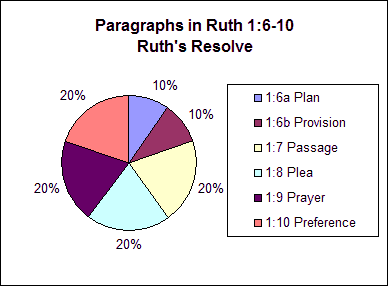
1:6a Plan 10%
1:6b Provision 10%
1:7 Passage 20%
1:8 Plea 20%
1:9 Prayer 20%
1:10 Preference 20%
Here we should see that the last four out of five verses contain the stressed information in this section – the Passage, plea, prayer and Ruth’s Preference.
Download Study - BACK TO RUTH - GROUP STUDIES HOMEPAGE - BACK TO AncientPath HOMEPAGE
The Book of Ruth Bible Study materials on this website are a ministry of AncientPath.net and are made available here free and may be copied for use in Bible study groups, in limited numbers, providing that no charge is made for them. Items that appear as copyrighted materials that are not of our authorship are not to be copied without the express permission of the original copyright holders. Every effort has been made to give proper footnote credit for items that are quoted. No further distribution or use of these materials is allowable under U.S. or International Copyright Law without the express permission of AncientPath.net. ©2008 AncientPath.net, All rights reserved.
J.
Deering [AncientPath.net] is the author and editor of this study.
AncientPath.net © 2024
Jeremiah 18:15
"Don't stumble from the Ancient Path.”