|
The
Book Of Ruth |
Chapter
1: 1-5
"Ruth's Relationships"
J. Deering, AncientPath.net
Download Study -
BACK TO RUTH - GROUP STUDIES
HOMEPAGE -
BACK TO AncientPath HOMEPAGE
The Book of RUTH – 2 Writer’s Comments:
"What an opportunity to show
how mankind progresses when completely free - free of God and man, but it didn't
work out that way; the greater Israel's freedom, the deeper their bondage
became. The more they did as they pleased, the less pleased they were with what
they did. The more they became what they wanted to be, the less they wanted to
be what they became.
Ruth is the eighth book of the Bible. Eight is the
number of new beginnings in the Scriptures.
Ruth is the sunrise after a
dark night of sin, immorality, and corruption. ruth lifts the curtain just
enough for us to see the unshaken God, directing the drama of the ages on the
stage of earth with actors who are not fully aware of where their parts fit into
the script.
Abraham running to Egypt to escape a famine - the
Hebrew people enslaved for 430 years." And God uses Joseph to bring them
redemption.
“The book of Ruth is of skyscraper significance. It is
read by the nation of Israel on the day of Pentecost, and it should prove
suggestive to the Christian. Pentecost is the birthday of the Church. Pentecost
marks the "Bethlehem of the Holy spirit," for He came on that day to indwell
human flesh. Pentecost is the line of demarcation between law and grace and the
book of Ruth tells the story of grace. It is pure grace from beginning to end.
She believed Boaz, and he brought her into his heart and home... by Grace she
was saved through faith. Boaz, the Kinsman-Redeemer. Boaz furnishes us with a
miniature figure of the Lord Jesus Christ as the Redeemer. A full treatment of
the theme of redemption necessitates a careful consideration of the book of
Ruth."
An Introduction to the Book and Chapter 1:1-5
Welcome to the study of the
Book of Ruth. These studies are specifically designed to help you learn both the
book – and how to study all the books of the Bible. You will learn about
CONTEXT, WORD MEANINGS, HOW TO PUT THE BIBLE TOGETHER AS ONE BOOK, and much
more.
“Picking up in the days when the judges ruled, the
book of Ruth tells the story of Naomi – The wife of a man named Elimelech, and
their two sons – from the town of Bethlehem in Judah. This man and his family
decide that the hand of the Lord is too hard upon them, and they forsake Him and
their covenanted country in order to satisfy their needs, and they moved to a
town in the land of Moab. Both of the sons then married Moabite women. Mahlon
married a woman named Orpha, and Chilion married a woman named Ruth. A farmer
named Boaz will, largely, complete the character list of the story.
The four chapters of the book
are each designed with intentional symmetry. The first and last chapters reflect
how loyalty turned this story of tragedy and death into a story of joy and
birth. The inner chapters show how Naomi and Ruth make a plan, followed by an
encounter between Ruth and Boaz, followed by Naomi and Ruth rejoicing.
Curiously, God is hardly
mentioned in the book of Ruth. At a time when we look for God to be active
through a judge or king, God instead worked out his will through the everyday
faithfulness of his people. This faithfulness not only benefits Naomi and her
family but goes on to bless the world through the family of David, the line from
which the Messiah would eventually come.”
The Book of Ruth – General Introduction
The time: 1322-1312 B.C. (approx.)
A time of national darkness - The time of the book of
Judges, in the midst of Israel's Rebellion when: "Every man did right in his own
eyes." (Judges 17:6).
The Place: Bethlehem, Judah
The place of the birth of Jesus, The Christ
The family "hometown"
Ruth gives us an insight into
the domestic life of the Nation during the time of its anarchy under the rule of
Gideon or Jephthah. Samuel may have been the author, but no one knows exactly
where or when it was written. This book, written on a separate scroll was, and
still is, read at Pentecost, the Hebrew harvest festival.
Ruth was the great-grandmother
of David. This book establishes the lineage of David, an ancestor of Christ. It
tells of the beginning of the Messianic family, within the Messianic nation,
into which over a thousand years later the Messiah was to be born.
Boaz was the son of Rahab, the
harlot found in Jericho (Joshuah Ch-2). David’s great-grandmother was a
Moabitess, and his great-grandfather was half Hebrew and half Canaanite.
The book of Ruth gives to us
God’s intimate story of His love for His people.
The book of Ruth has a very
vivid central theme - Redemption. The first chapter introduces us to the
predicament and the remainder of the book gives us wave after wave of truth
concerning God's redemptive heart. Whether you look at the book from the
viewpoint of the characters of the story, or its typology of the Nation of
Israel, or the extended typology of the individual believer in Jesus Christ and
the Body of Christ (the Church), every page abounds with truths and
relationships that tell of the wonderful and graceful redemptive nature of our
God.
We will study the book of Ruth in stages. Stage-1: We
will study the remarkable story of Naomi, Ruth and Boaz. Stage 2: Then move on
to study the parallels between the characters of the book and the actions and
relationships between Israel and the Lord God of Israel. Stage 3: We’ll look for
the wonderful truths that can be gleaned concerning God's amazing grace toward
the one who repents (one who changes his mind - toward God and away from sin and
idols) in the aspect of salvation in Jesus Christ, and also the one who is
already a faithful believer but has been disobedient in temptation and sin. The
former is the story of coming to Christ because you will have no other, and the
latter is the story of the wayward believer who realizes his error and seeks to
wholeheartedly agree with God about his sin and return to full fellowship
through confession.
Ruth was written sometime between 150 and 180 years
after the events in the book as Chapter 4:22 follows the lineage through David,
who dies in 1058 BC, at the age of seventy, he was High King of Israel.
Elimelech and Naomi were of
the tribe of Ephraim, the son of Joseph, the son of Jacob and Rachel, the son of
Sarah and Abraham (brother to Haran, whose son was Lot). They lived in the city
of Bethlehem (sometimes referred to as Bethlehem-Judah). It is interesting to
note that there are two Bethlehems in the scriptures and that this one is called
out by name as Bethlehem “City of Bread,” so as to not confuse it with the other
Bethlehem in the North of Israel.
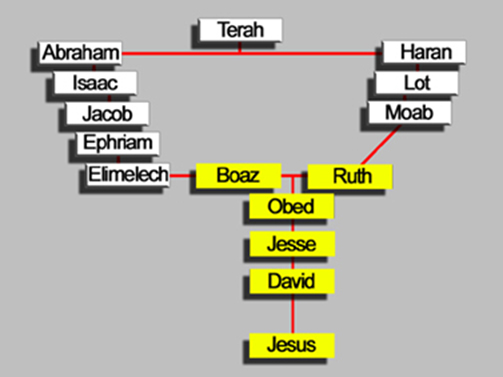
THE GENEALOGIES
Ruth was the great-grandmother of David.
This book establishes the lineage of David, the ancestor of Christ. It tells of
the beginnings of the Messianic family from Abraham to Boaz, within the
Messianic nation into which over a thousand years later the Messiah was to be
born.
Mary’s Lineage (David to Jesus)
David, Nathan, Mattatha, Menna,
Melea, Eliakim, Jonam, Joseph, Judah, Simeon, Levi, Matthat, Jorim, Eliezer,
Joshua, Er, Elmadam, Cosam, Addi, Melchi, Neri, Shealtiel, Zerubbable, Resa,
Johanan, Joda, Josech, Semein, Mattathias, Maath, Naggai, Hesli, Nahum, Amos,
Mattathias, Joseph, Jannai, Melchi, Levi, Matthat, Eli, (Mary, the wife
of) Joseph, Jesus [Luke 3:23-31]).
Joseph’s Lineage
(David to Jesus)
David, Solomon, Rehoboam, Abijah, Asa, Jehosaphat, Joram,
Uzziah, Jotham, Ahaz, Hezekiah, Manasseh, Amon, Josiah, Jeconiah (also named
Jehoiachin), Shealtiel, Zerubbabel, Abiud, Eliakim, Azor, Zadok, Achim, Eliud,
Eleazar, Mathaqn, Jacob, Joseph, Jesus [Matthew 1:6-16])
Note that the two versions of
the lineage of Jesus differ from Abraham to Jesus. Scholars agree that the two
lineages are that of each side of Jesus’ family. His mother’s family (Luke) is
traced to show that Jesus has the human physical seed of Abraham. Even though
Jesus is Virgin born He is human flesh through Mary and that human flesh was
directly traceable to Abraham and gives Her family both genetic and national
authority, and her offspring has the Right to become KING of Israel.
Joseph’s family lineage
(Matthew) is traced to show that Jesus has the national authority for
inheritance of The People and The Land – but not KING. In Jeremiah 36:30 God
proclaims that no member of Jehoiachin’s (Jeconiah) family will ever set on the
THRONE of Israel.
The combination of the two genealogies is remarkable
in that Jesus has every RIGHT to be Priest, King, and Prophet, able to be The
Christ, and fulfill every demand of Scripture, even to the extent of being the
descendant of Jeconiah, for while Joseph is his descendant, The Holy
Spirit IS, and Joseph IS NOT the physical father of Jesus.
There are many interesting
things to notice in this book. Ruth was a Moabitess. These people were
descendants of Lot (nephew of Abraham). They were Gentiles. God, in establishing
the family, which was to produce the world's Savior, chose a beautiful gentile
girl, led her to Bethlehem and made her the bride of Boaz. We shall keep our
eyes open during this study for evidence of “The Bride of Christ.” This is God's
grace. He adopts the Gentiles into Christ's family. Of course, we know that
although Ruth was born an unbeliever, through her first husband, or Naomi (her
mother-in-law), she learned of and worshiped the one true God.
Boaz was the son of Rahab, the
harlot found in Jericho whose husband is Salmon who probably was one of the two
spies sent into Jericho who rescued Rahab before “The walls came tumbling down.”
The book of Ruth gives us
God's intimate story of His love for His people then as now, in the Old
Testament through the Nation of Israel, and in the New Testament through the
Children of His Son Jesus.
Two Quick Overviews of
Ruth’s Story
The Physical Story: (Keil and
Delitzsch1)
The book of
Ruth introduces us to the family life of the ancestors of king David, and
informs us, in a simple and attractive form of historical narrative, and one in
harmony with the tender and affectionate contents, how Ruth the Moabitess, a
daughter-in-law of the Bethlehemite Elimelech, of the family of Judah, who had
emigrated with his wife and his two sons into the land of Moab on account of a
famine, left father and mother, fatherland and kindred, after the death of her
husband, and out of childlike affection to her Israelitish mother-in-law Naomi,
whose husband had also died in the land of Moab, and went with her to Judah, to
take refuge under the wings of the God of Israel (chap. 1); and how, when there,
as she was going in her poverty to glean some ears of corn in the field of a
wealthy man, she came apparently by accident to the field of Boaz, a near
relation of Elimelech, and became acquainted with this honorable and benevolent
man (chap. 2); how she then sought marriage with him by the wish of her
mother-in-law (chap. 3), and was taken by him as a wife, according to the custom
of Levirate marriage, in all the ordinary legal forms, and bare a son in this
marriage, named Obed. This Obed was the grandfather of David (chap. 4), with
whose genealogy the book closes.
The Spiritual Story
(C. I. Scofield)2
Author: Unknown
Theme: Kinsman-Redeemer
Date of writing: c. 10th Cent. B.C.
In Ruth the events set forth are contemporary with the
first half of Judges. In contrast with that period of strife and bloodshed is
this lovely idyllic story, renowned in world literature as a masterpiece of
narration. The book, however, is more than a beautiful picture of pastoral life;
for behind the story of Ruth's fidelity there are clear implications of our
Lord's redeeming work. Boaz, the kinsman-redeemer, points to Christ; Ruth
portrays those who enter into a new life through trust in Him. It is significant
that both Boaz and Ruth are mentioned in the Messianic genealogy (Mt. 1:5)
The book is divided
according to chapters, as follows:
I. Ruth’s Relationships, Resolve, Return, & Reception
II. Ruth’s Guidance, Gleaners, Grace, & Gladness
III. Ruth’s Rest
IV. Ruth’s Reward
The Characters
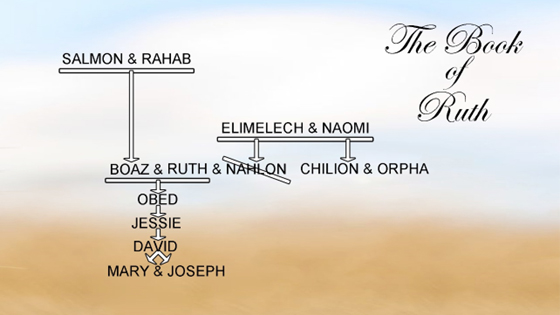
Elimelech was the husband of Naomi, they lived in Bethlehem,
Judah.
Naomi
is Elimelech's devoted wife.
Mahlon is Elimelech and Naomi's
First-Born Son.
Ruth is the Moabite wife of Mahlon, married to him in Moab.
Chilion is Elimelech and Naomi's
second son.
Orpah is the Moabite wife of Chilion, married to him in Moab.
Boaz is a man from Bethlehem, Judah,
that will eventually become the husband of Ruth by Levirate marriage (Kinsman
Redeemer).
Obed
is the First-Born Son of Ruth and Boaz.
So, now you have seen the
individual trees in the forest, let us now turn our attention to a bigger frame
of reference. This story has to do with the provision of God to work through
human circumstances to bring about His will. Through this story God is telling
us of the great depth of His wondrous grace.
The stage is set. The time is
described as “In the days when the judges governed.” These were not days that
included the deep fellowship of God and His people the Israelites. These were
days when Israel had spiritually left the God of Israel. Joshua has died and
with him died the days of a leader fully dedicated to doing the will of God. God
gave Israel the “promised land” under the leadership of Joshua. God renewed His
covenant under Joshua. It was Joshua who said, “As for me and my house, we will
serve the Lord.” It was Joshua who on his deathbed called upon Israel to
reaffirm her vows before the Lord and her willingness to serve Him and Him
alone.
And it was Joshua who proclaimed of Israel, at the end
of his life, “Ye cannot serve the Lord.” He knew and understood
that such a wicked and stiff-necked people would not and could not walk with
God.
Then came the Canaanites, the Moabites, the
Midianites, and the Philistines. These were nations that God had commanded
Israel to remove from His land. In their battles and wars… they never
accomplished God’s command. 13 Judges (Rulers raised by God from among the
people) needed to come to Israel to rescue the Nation during these years.
It is before this backdrop
that the story of Ruth is told. The best scholarship says that it takes place
during the time of the Judge Gideon, when Israel is under the attack from the
Midianites.
The story told in Ruth is three-fold.
First there is the story of the
characters of the book and the events of their lives.
Second there is a bigger story that
is symbolized by these characters of how God works and moves among His People,
the Nation of Israel.
Lastly, there is the foreshadowing of God’s precious
relationship to His Church, The Body of Christ. God does not change; His grace
is always the same and it is based on the individual’s willingness to believe
and trust in Him without coercion on His part.
THE VISUALIZED TEXT
(NASB)
1:1-5 –
Ruth’s Relationships
1:1-2 –
Sojourn to Moab
1:1a – Judges Ruled
Now
it came about
in the days when the judges
governed (or, judged),
that there was a famine in
the land.
1:1b
And
a certain man of Bethlehem
in Judah
went to sojourn in the land
of Moab
with his (Lit., he, and ...)
wife and his two sons.
1:2
And
the name of the man
was Elimelech (Name: "my God
is King"),
and
the name of his wife
Naomi (Name: "pleasant,
lovely");
and
the names of his two sons
were Mahlon (Name: "puny")
and Chilion (Name: "pining"),
Ephrathites (a designation
for inhabitants of Bethlehem) of Bethlehem in Judah.
Now
They entered the land of
Moab and
(They)
remained there.
Brief Commentary on Ruth 1:1-2, Sojourn to Moab
The previous Old Testament Book, the book of Judges,
involves God chastising Israel because of unbelief. Each judge that God raised
up to do this was like a dictator. There were 13 judges spread over 7 periods of
time. Each period of time was marked by the cycle of 1. Failure, 2. Discipline,
3. Crying out to God, 4. A short-lived time of faith restored. The length of
these periods lasted from the Exodus to King Saul (about 300 years).
In verses 1-2 we learn that
God is in the middle of chastising Israel through a great famine brought that is
probably the result of years of war with the Midianites who intentionally killed
the productive land with the spreading of salt. Elimelech, Naomi, their sons,
and their daughters become characters that play the part of the Nation of Israel
in this saga. Elimelech, Naomi, and their sons have gone astray; probably
somewhat involved in the idolatry that was sweeping Israel. When God brings His
chastising hand against them – they flee. Yes, they flee to a land that has food
to spare, but they also are fleeing to a land, ruled by their cousins, in Moab;
The Moabites, and it is a hotbed of pagan idol worship. Moab as a nation came
about as the result of Lot’s two daughters who knew that Lot wasn’t going to
have any more children – specifically a male to carry on the family line. So
they got him drunk, camouflaged themselves, and lay with him to get pregnant –
the result was a son named Moab.
The Hebrew words used to
describe Elimelech and Naomi’s intentions indicate that they intended to remain
in Moab. It’s also true that the Midianites, Israel’s constant enemies, lived in
Moab. Picture here some children of Israel making their decisions based on food,
water, and political advantage, moving into the land of their enemies… anything
but faithfulness to her God.
Naomi’s husband, Elimelech,
was born and raised in Bethlehem, Judah. (There is also a Bethlehem in northern
Israel).
Here’s Bethlehem, Judah.
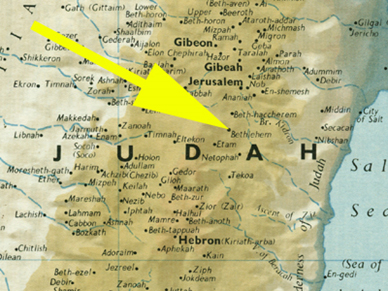
Here’s the country of MOAB
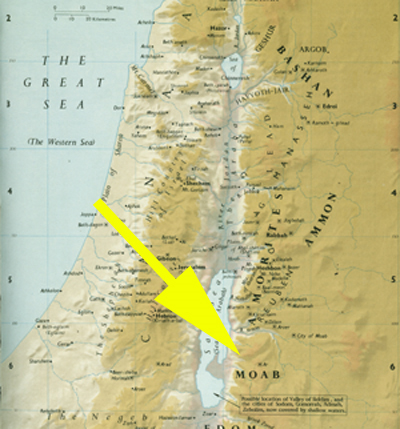
The nation of Moab came about
as Abraham’s nephew Lot’s son Moab moved his family across the Jordan and South
to the land just East of Judah sometime in the previous twelve hundred years.
Elimelech, in the midst of a terrible famine chooses to take his wife and two
sons to Moab. Bible teacher Matthew Henry writes: “Elimelech's care to provide
for his family was not to be blamed; but his removal into the country of Moab
could not be justified. And the removal ended in the wasting of his family. It
is folly to think of escaping that cross, which, being laid in our way, we ought
to take up. Changing our location is seldom mending our problem. Those who bring
young people into bad acquaintance and take them out of the way of public
ordinances, thought they may think them well-principled, and armed against
temptation, know not what the end will be.”
At the end of verse 2, we
learn that this family were Ephrathites – they were of the tribe of Ephraim who
settled in the Land of Judah near Mount Ephraim. Joshua was buried there. It is
also the birthplace of Jesus. Bethlehem, meaning “the house of bread” is one of
the most famous places of Bible History. King David was the son of Jesse – born
in Bethlehem of Judea. Micah, the prophet, prophesized that the Messiah would be
born there. Benjamin, one of Jacob’s children was born there. We’ll find later
in Ruth that a son will be born to her, there in Bethlehem, named Obed will be
the grandfather of King David.
1:3-5 – Sorrow In Moab
1:3
Then
Elimelech,
Naomi's husband,
died;
and
she was left with her two
sons.
Brief Commentary on Ruth 1:3, Sorrow In Moab
Right away we need to notice that this verse starts
with the word “Then.” When used as a transitional word it means a major change
is taking place. Living in Moab for some time, everything is going along well.
Then… Elimelech dies. God moves against them for their stiff necks and their sin
– Just as He does for the Nation of Israel. Consider this: God’s People Dying of
Famine … In The Promised Land. Move out of God’s promised land and death follows
them.
With Elimelech’s death all inheritance, according to
Hebrew law, moves to the sons – as women cannot inherit. The older son, Mahlon,
receives a double portion and the younger Chilion a single. And so goes the
Nation as God moves to purify His people. Many lives are lost when God moves
against sin and the sinner – without belief… eternal Godly inheritance is lost
forever. His inheritance remains intact to those who believe and are obedient in
their faith.
Now, Naomi is left with two adult sons.
1:4a – Sisters-in-Law
And
they took
for themselves Moabite women as wives
the name of the one was Orpah and
the name of the other Ruth.
Brief Commentary on Ruth 1:4a, Sisters-In-Law
While there, they continue their waywardness from God
by allowing their sons Mahlon and Chilion to take Moabite women as their wives.
The Targum says, "they transgressed the decree of the word of the Lord and took
to them strange women."
The Moabites were not among the list of nations
forbidden for marriage to an Israelite, but they were on the list of those who
would not be considered to become members of the Nation of Israel, even if
proselytized, until after the tenth generation (Deut. 23:3-6). Other existing
nations were also “no marry” countries – The Hittites, the Girgashites, The
Amorites, the Canaanites, the Perizzites, the Hivites, and the Jebusites (Deur.
7:1-3).
It's also interesting that the text says that they
took Moabite women for themselves,” unbelieving idol worshippers. This is a
probable reference to that famous verse “and everyone did what was right in
their own eyes.” “They did not take Hebrew women “To please the Lord.” Poor
Naomi, the return to Israel would be virtually impossible as her sons would be
shunned because of their marriages to pagan women, and Naomi is now their ward.
It should be recognized that God is exercising His
will through these events. While the characters may make moves against His will,
God is fully in control. The family line will be established and lead to the
Messiah.
1:4b Their Stay in Moab
And
they
lived there about ten years.
Brief Commentary on Ruth 1:4b, Their Stay in Moab
As is often the case the plans of mice and men often
go astray. Elimelech’s family settles into the land of Moab and no longer become
sojourners. The sons have forsaken Judah and their God. While they are still
members of the tribe of Judah, they have left the fellowship of their God and
are now living amongst the pagans and idolaters of the land of Moab. The famine
in Judah, brought about as a chastisement from God for these very acts of the
Nation goes on and on – for 10 years.
1:5 – Sustained Sorrow in Moab
Then
both (Lit., both of them)
Mahlon and Chilion also died;
and
the woman was bereft of
her two children and
her husband.
Brief Commentary on Ruth 1:5, Sustained Sorrow in
Moab
We
begin this verse with the word “then” again. The context indicates a word of
“results.” The result of their waywardness (as also the waywardness of the
nation of Judah) is the death of many of the rebellious.
Not only is Naomi’s husband
dead but also the husbands of her daughters-in-law. The word “bereft” indicates
that she was now desperately alone with only a pair of Moabite daughters-in-law.
Her sons died childless.
So, Naomi loses her husband and then her two sons. She
is left alone, even the inheritance that would have been hers from Elimelech was
lost to her sons. Now, as inheritance was only allowed through the men… all was
lost, if she returned to Israel, whatever she had left would be directed to the
oldest living male family member. Thus, everything she had was to be forfeited
if she returned to her people in Israel. And so, we are introduced to these two
young women, Orpah and Ruth. All three were now effectively indigent, living in
a foreign land that hated the Jew.
And so goes the Nation as God
moves to purify His people. Without belief… eternal Godly inheritance is lost
forever. His inheritance remains intact to those who believe and are obedient in
their faith.
Verse Percentage Chart for Ruth 1:1-5
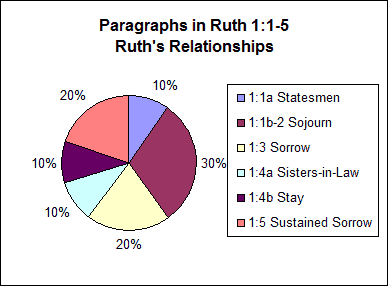
1:1a Statesman 10%
1:1b-2 Sojourn 30%
1:3 Sorrow 20%
1.4a Sisters-in-law 10%
1:4b Stay 10%
1:5 Sustained Sorrow 20%
How many words it takes
influences how the text is stressed, for instance here, the Sorrow is stressed
more in total (1:1b-2 & 1:5) than the Sojourn, all else much less. So, as you
read the text you should be moved by the Sorrow more than the journey from
Israel to Moab.
________________
1(Delitzsch, F., Keil, C. F., Commentary on the Old
Testament, in Ten Volumes, Volume II, Joshua, Judges, Ruth, I & II Samuel,
William B. Eerdmans Publishing Company, Grand Rapids, Michigan, 1978 reprint, p.
465).
2(Scofield, C. I., The New Scofield Reference Bible,
KJV, Oxford University Press, NY, 1967 Edition, p. 317)
The Book of Ruth Bible Study materials on this website are a ministry of AncientPath.net and are made available here free and may be copied for use in Bible study groups, in limited numbers, providing that no charge is made for them. Items that appear as copyrighted materials that are not of our authorship are not to be copied without the express permission of the original copyright holders. Every effort has been made to give proper footnote credit for items that are quoted. No further distribution or use of these materials is allowable under U.S. or International Copyright Law without the express permission of AncientPath.net. ©2008 AncientPath.net, All rights reserved.
J. Deering [AncientPath.net]
is the author and editor of this study.
AncientPath.net © 2024
Jeremiah 18:15
"Don't stumble from the Ancient Path.”
Original Class Date: 04/03/24
2025-03-28 updated