The Book of
Revelation - Home Groups - Home
Go To: AncientPath.net
LESSON 05
-
CHAPTER 1:9-20
Printed Version,
Pages 55 - 64
R E V E L A T I O N
Charles Caldwell Ryrie, p. 21-25
These lessons are
written as an accompanment to
Charles C. Ryrie's [1996] Book
REVELATION
Everyday Bible Commentary
Moody Publishers
Chicago
ISBN: 978-0-8024-1825-8
(You Must Own your own copy)
(Ryrie's book text is not included in these lessons)
THE VISION
OF CHRIST
I.
"THE THINGS WHICH YOU HAVE SEEN" 1:9-20
A. Circumstances
of the vision 1:9—11
1. Physical
Circumstances 1:9
2. Spiritual
Circumstances 1:10—11
B. Content of the
Vision 1:12—16
1. Position of
the Lord 1:12—13
2. Picture of the
Lord 1:14—16
3. A Little Bit
About Translation 1:12-16
C. Consequences
of the Vision 1:17—20
1. A word of
comfort 1:17-18
2. A word of
command 1:19-20
|
|
John’s prescribed outline for this book:
Revelation 1:19
“Therefore write:
The
Things which you have seen
[1:9-20]
The
Things which are [2:1-3:22]
The
things which will take place
After these things
[4:1-22:21]
Ryrie, P. 21-22
Commentary:
We will follow
Ryrie’s outline as it follows John’s text which delivers a pre-millennial focus.
The character of John’s recording of this vision is apocalyptic, which basically
means the telling of the future – a revealing. The Bible has several such
writings and the more important from the Old Testament are Isaiah, Ezekiel,
Daniel, Joel and Zechariah. There are many, many other pseudepigraphical
(non-biblical) apocalyptic writers and writings that all pretend to be Biblical
and written by those who have never listed their names as the authors. “The
reverent student, however, has little difficulty distinguishing the superlative
and inspired character of the genuine Apocalypse of John from these apocalyptic
writings which followed.”
[1]
THE VISION OF THE RISEN CHRIST
SECTION 1:
I.
"THE THINGS WHICH YOU HAVE SEEN" 1:9-20
A.
Circumstances of the vision 1:9—11
1. John’s
Physical Circumstances 1:9
Ryrie, P.
22 bottom
9 I,
John,
your brother and
fellow partaker in
the tribulation and
[the] kingdom and
[the] perseverance
which are in Jesus,
was
on the island called
Patmos because of
the word of God and
the testimony of Jesus.
COMMENTARY
John was exiled to the Isle of Patmos because of his willing witness and
testimony about Jesus Christ. He was sentenced to hard labor in the mines for
what seemed like the rest of his life, however, in A.D. 96, upon the death of
the then ruler Domitian, he was released and returned home to Ephesus till the
end of his life.
“John’s experiences paralleled those of the Old Testament prophets. Moses wrote
the Pentateuch in the wilderness. David wrote many psalms while being pursued by
Saul. Isaiah lived in difficult days and died a martyr’s death. Ezekiel wrote in
exile. Jeremiah’s life was one of trial and persecution. Peter wrote his two
letters shortly before martyrdom. Thus, in the will of God the final written
revelation was given to John while suffering for Christ and the Gospel.”
2. John's Spiritual Circumstances 1:10-11
10 I
was
(became) in the Spirit (pneumatai) on the Lord’s day, and
I heard behind me a loud
voice
like the sound of a trumpet, 11 saying,
“Write in a book what you see, and send it to the seven churches: to Ephesus and
to Smyrna and to Pergamum and to Thyatira and to Sardis and to Philadelphia and
to Laodicea.”
Ryrie, P. 23 top
Commentary:
What Ryrie has said means that “In the Spirit on the Lord’s day,” tells us that
John was in his mind seeing the days of these events as if he was there when
they take place – placing a very clear and bright picture of each event.
Secondly verse 11 - Here we see the command to write, which he uses twelve times
in the book, indicates that John is to write what he sees after each individual
vision – with the exception of the vision in Ch. 10:4, when he is told not to
write what he sees in the seven things of the seven thunders.
B.
The Content of the Vision 1:12—16
1. The Position
of the Lord 1:12—13
12 Then
I
turned to see the voice that was speaking with me.
And
having turned
I
saw seven golden lampstands; 13 and
in the middle of the lampstands
I
saw one like a son of man,
Clothed
in a robe reaching to the feet, and
girded across His chest with a golden sash.
Ryrie, P. 23 bottom
Commentary:
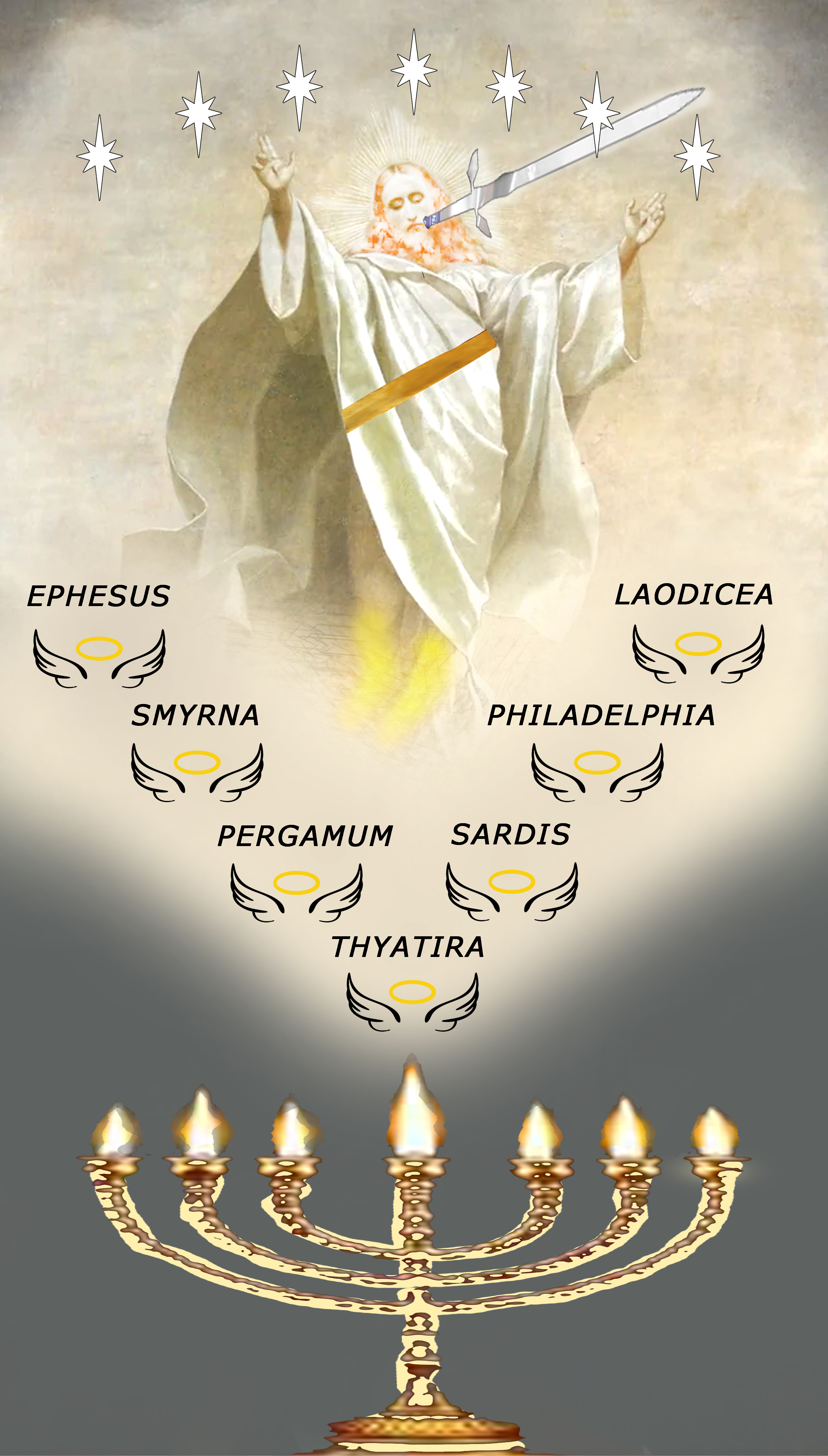
You can turn back to page 56 and look at the image of Christ there. It’s the
closest I could come with the time and space in preparation for these lessons.
What John saw is the symbolic representation of who was talking to him. It was,
of course Jesus.
There, He is in the midst of Sevens: Seven stars, Seven Lamps, Seven Angels, and
Seven Churches. Seven being the biblical number of perfection, we should see
that this is Christ’s picture of the importance of the book. In the center of
all things is the very Son of God, the believer’s Savior, the Creator, The
sustainer, the one who is the focus of the entire Bible. Around Him is the
creation, the righteous angels, the ministries of God’s Holy Spirit, and last,
but not least, the seven churches representing the collections of all believers
in Christ over all time – His Kingdom. He is The One! The question should arise
– If now you see Him as this central figure – where do you see mankind in
relation to the Bible revelation. Has it occurred to you that, if you are one
who see’s Jesus, The Christ, The Anointed one, The Savior, and believes in Him
in the biblical way, the Shema, originally from Deuteronomy 11, and also
found in Mark 12:
“And one of the scribes came up and
heard them disputing with one another, and seeing that he answered them well,
asked him, “Which commandment is the most important of all?” Jesus answered,
“The most important is, ‘Hear, O Israel (those who were to believe at that
time): The Lord our God, the Lord is one. And you shall love the Lord your God
with all your heart and with all your soul and with all your mind and with all
your strength.’ The second is this: ‘You shall love your neighbor as yourself.’
There is no other commandment greater than these.”
Then you should also see the salvation of men, women, and children to become
the "Bride of Christ" eternally is the outcome of the very singular purpose
of God’s almighty plan to bring Him here, to live and die, be resurrected and
ascended.
2. The Picture of
the Lord 1:14—16
His Head 1:14
His Eyes 1:14
His Feet 1:15
His Voice 1:15
His Right Hand 1:16
His Mouth 1:16
His Countenance 1:16
14 His
head and His hair were white like white wool, like snow; and
His eyes were like a flame of fire.
15 His
feet were like burnished bronze,
when
it has been made to glow in a furnace, and
His voice was like the sound of many waters.
16 In
His right hand He held seven stars, and
out
of His mouth came a sharp two-edged sword; and
His face was like the sun shines in its strength.
Ryrie, P. 24 top
Commentary:
Nothing more than Charles Ryrie has revealed here… except:
Verse 16a – “Stars,“ “gleamers.” The Greek word is
“astteras” from “astaros” used in astronomy and magic, “as living beings endowed
with reason; a star; Rev 1:16 conjectured as a constellation – the seven stars
of “The Great Bear.” Guardian angels of the 7 churches, etc. So, you can see
that when deciphering imagery there are many routes to take. One must keep their
focus on the purpose of the imagery.
C.
Consequences of the Vision 1:17—20
1. A Word of
Comfort 1:17-18
17 When
I saw
Him,
I fell at His feet like a dead man. And
He placed His right hand on me, saying,
“Do
not be afraid;
I am the first and the last, 18 and
[I am] the living One; and
I was dead, and behold,
I am alive forevermore, and
I have the keys of death and of Hades.”
Ryrie, P. 25 top
Commentary:
Ryrie makes it really clear as to the experience of John the Apostle. Here John
is, a prisoner forced into doing hard labor in an underground mine – against his
will, put there by royal Roman decree – No sunlight, No fresh air, lots of sweat
and misery… And there, upon the vision of Christ, which Christ has sent to him,
John falls to the ground in humility. And there, Jesus places His right hand
(the right hand of God) on him and tells him not to be afraid.
We should ask ourselves if that has happened to us. At the peak of our misery…
Jesus places His right hand upon us and says, “Do not be afraid.” Do we hear
Him? Do we believe Him?
Too often we may find ourselves embedded in our human ways and ideas. Too often
buried in our questions as to “Why God?” When He is right there telling us, “Do
not be afraid,” for from His viewpoint… our eternal existence is intact and
waiting for us. Our death unites us to Him… forever… if we are His. He is all in
all. He was dead and is now alive, and He is in control of everything in the
past, the present, and the future.
2. A Word
of Command 1:19-20
“19 Therefore [you]
write
the things which you have seen, and
the things which are, and
the things which will take place after these things.
20 As
for the mystery of
the seven stars
which you saw in My right hand, and
the seven golden lampstands:
the seven stars are the angels of the seven churches, and
the seven lampstands are the seven churches.”
Ryrie, P. 25 mid
Commentary (Important):
And there it is again, the past, the present, and the future. Ryrie reminded us
that the seven (perfect) angels (messengers) can be both God’s Angels and / or
those humans who God has placed in each type of church for leadership. Again, we
can turn back to page 56 (in this document) and review what’s there: The Seven
Churches are the full focus of Christ’s revelation of what has been seen, and
what is being seen. As we dig through our study of the book Chapters 2 and 3
will teach us about seven different church types using these 7 churches of the
Roman province of Asia. Your church may be one of these… or made up from parts
of each of these 7 example churches of John’s time. It is for us to recognize
that each of these examples is part of John’s vision of the place and power of
Jesus Christ above all things.
[Mark 4:21a]
He [Jesus] said to them,
[Mt 5:14a]
“You are the light of the world.
A
town built on a hill cannot be hidden.
[Mk 4:21b]
Do you
[Lk 8:16a]
light a lamp and hide it in a clay jar,
[Mk 4:21b]
put it under a bowl or a bed?
[Mk 4:21c]
Instead, don’t
you put it on its stand?
And it gives light to everyone in the house,
[Lk 8:16c]
and those who come in can see the light.
[Mk 4:22a]
For whatever is hidden is meant to be disclosed, and whatever is concealed is
meant to be brought out into the open.
[Mk 4:23a]
If anyone has ears to hear, let them hear,
[Lk 8:18a]
and consider carefully how you listen.
[1] Walvoord, John, “The Revelation
of Jesus Christ, a commentary by John F. Walvoord, Moody Press Chicago
1966.
The Book of
Revelation - Home Groups - Home
Go To: AncientPath.net
The "The Ancient Path" Study materials on this website
are made available here free and may be copied for use in Bible study groups, in
limited numbers, providing that no charge is made for them. Items that appear as
copyrighted materials that are not of our authorship are not to be copied
without the express permission of the original copyright holders. Every effort
has been made to give proper footnote credit for items that are quoted.
J. Deering [AncientPath.net] is the author and editor
of this study.
AncientPath.net © 1983 - 2025
Jeremiah 18:15
"Don't stumble from the Ancient Path.”
2025-10-24